What Does P0420 Mean? Causes, Symptoms, Diagnosis & Fixes

Quick Answer
P0420 means “Catalyst System Efficiency Below Threshold (Bank 1).” Your engine computer has detected that the catalytic converter on Bank 1 is not cleaning exhaust gases as efficiently as expected. A worn converter is possible, but exhaust leaks, oxygen-sensor problems, misfires, or incorrect fuel mixture can also contribute. A NHTSA-hosted manufacturer service bulletin confirms the standard P0420 description.
What to Check First
- Scan all codes: Other trouble codes can reveal the problem that triggered P0420.
- Check for misfires: Unburned fuel can overheat and damage a catalytic converter.
- Inspect exhaust leaks: Leaks near the oxygen sensors can distort their readings.
- Review O2 data: Compare upstream and downstream oxygen-sensor behavior with a capable OBD2 scanner.
- Confirm before replacing: Don’t buy a catalytic converter based on P0420 alone.
Important
- If the check engine light is flashing or the engine is misfiring badly, reduce driving and get the vehicle diagnosed promptly.
If your OBD2 scanner shows P0420, don’t assume it automatically means an expensive catalytic converter replacement. I treat P0420 as a diagnostic starting point, not a parts order.
The code tells you what the engine computer detected. This guide explains what P0420 means, what causes it, how to diagnose it, and when the converter itself is likely at fault.
In This Guide
What Does P0420 Mean?
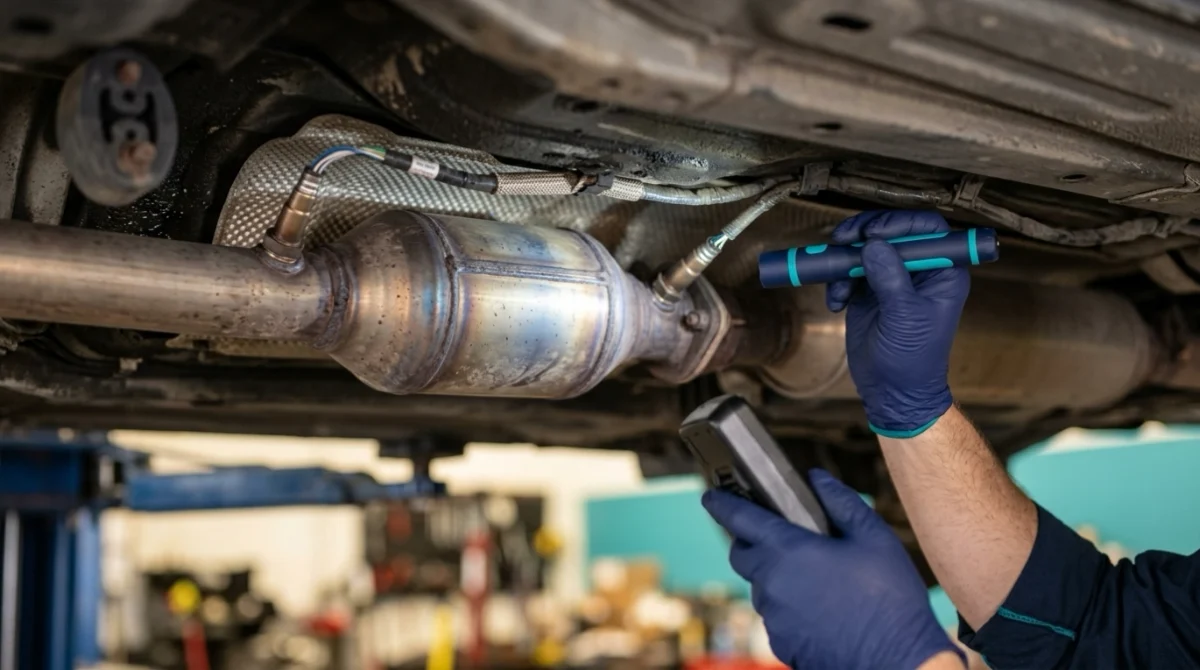
P0420 means the engine computer believes catalytic-converter efficiency on Bank 1 has fallen below its calibrated threshold. It is a generic OBD-II powertrain diagnostic trouble code.
P0420 definition: Catalyst System Efficiency Below Threshold — Bank 1.
The catalytic converter sits in the exhaust system. It helps convert harmful exhaust pollutants into less harmful gases before they leave the tailpipe.
Bank 1 means the side of the engine containing cylinder number one. On many inline engines, there is only one cylinder bank.
How does the computer know the catalyst is inefficient?
The engine control module uses oxygen sensors to monitor exhaust conditions before and after the catalytic converter. These are commonly called the upstream and downstream O2 sensors.
A healthy converter changes the exhaust enough that the downstream sensor normally behaves differently from the upstream sensor. When their signals become too similar under the required test conditions, the computer may determine that catalyst efficiency has dropped.
- Upstream sensor: Helps the computer monitor combustion and fuel mixture.
- Catalytic converter: Treats exhaust gases as they pass through the exhaust.
- Downstream sensor: Helps the computer monitor catalyst performance.
- ECM/PCM: Compares sensor information against programmed operating limits.
That distinction matters. P0420 describes a monitored result, not one guaranteed failed component.
Section Takeaway: P0420 means catalyst efficiency on Bank 1 tested below the vehicle’s programmed limit. It does not prove the converter is the only possible cause.
What Symptoms Can P0420 Cause?
Many vehicles with P0420 have no obvious driving symptoms besides a steady check engine light. Others develop performance or exhaust-related symptoms when the underlying problem becomes more serious.
AAA also identifies catalytic-converter and oxygen-sensor problems among issues that can illuminate the check engine light.
Common P0420 symptoms
- Check engine light: This is often the first and only noticeable sign.
- Failed emissions inspection: A stored emissions-related fault can interfere with an inspection result.
- Reduced acceleration: A restricted or damaged converter can limit exhaust flow.
- Poor fuel economy: Fuel-control problems associated with the fault may increase consumption.
- Unusual exhaust smell: Some catalyst or fuel-control problems can produce a strong exhaust odor.
- Rattling underneath: A physically damaged converter substrate can sometimes rattle.
A lack of symptoms doesn’t mean you should erase the code and forget it. The monitor may run again and restore P0420 after the correct driving conditions occur.
Steady light versus flashing light
A steady check engine light with normal drivability usually gives you time to arrange diagnosis. A flashing light deserves much faster attention.
A flashing check engine light can accompany a severe misfire. Raw fuel entering the exhaust can create extreme heat and damage the catalytic converter.
Technician’s note: if the light flashes and the engine is shaking or losing power, don’t keep driving just to see whether it clears itself.
What Causes a P0420 Code?
A degraded catalytic converter is an important P0420 cause, but it is not the only one. The correct diagnosis looks at the entire combustion and exhaust system.
I pay close attention to other stored codes before blaming the converter. A catalyst can be the victim of another fault rather than the original problem.
Most important causes to investigate
- Worn catalytic converter: The catalyst can lose its ability to process exhaust efficiently with age or contamination.
- Engine misfire: Unburned fuel can enter the exhaust and overheat the converter.
- Rich fuel mixture: Excess fuel can raise catalyst temperatures and affect emissions performance.
- Lean or air-fuel problems: Incorrect mixture control can change oxygen-sensor patterns and catalyst operation.
- Exhaust leak: Outside air entering near a sensor can alter oxygen readings.
- Oxygen-sensor problem: A slow, contaminated, damaged, or incorrectly reporting sensor can complicate catalyst monitoring.
- Oil or coolant consumption: Contamination from an engine problem can shorten catalyst life.
- Wiring or connector fault: Damaged O2-sensor wiring can create misleading sensor information.
P0420 causes compared
| Possible Cause | Useful Clue | What to Verify | Replace Converter First? |
|---|---|---|---|
| Degraded catalyst | Rear O2 pattern begins resembling front sensor | Sensor data, leaks, other codes and manufacturer test procedure | Only after confirmation |
| Misfire | P0300-series codes, shaking or poor running | Ignition, fueling and mechanical condition | No |
| Exhaust leak | Ticking, soot or visible exhaust damage | Exhaust integrity near sensors and catalyst | No |
| O2 sensor or circuit | Implausible or abnormal sensor behavior | Live data, wiring and vehicle-specific specifications | No |
| Fuel-control problem | Fuel-trim or mixture-related codes | Fuel trims, intake leaks, fueling and sensor inputs | No |
Pro tip: never replace an expensive emissions component until you’ve checked for the fault that may have damaged it.
Section Takeaway: A failed converter can trigger P0420, but misfires, exhaust leaks, fuel-control faults, contamination, and sensor issues should be ruled out first.
How Do You Diagnose P0420 Correctly?
Diagnose P0420 by checking the complete scan report, engine condition, exhaust integrity, and oxygen-sensor data before condemning the converter. A basic code reader can identify P0420, while live-data capability makes deeper diagnosis easier.
The exact test procedure varies by make, model, engine, and year. Manufacturer service information should take priority over a universal internet procedure.
A practical diagnostic order
- Scan every control module you can access. Record P0420 plus any misfire, oxygen-sensor, fuel-trim, or temperature-related codes.
- Save freeze-frame data. This records operating conditions when the computer detected the fault.
- Address serious companion codes first. A current misfire or fuel-control fault may explain why catalyst efficiency dropped.
- Inspect the exhaust system. Look for cracks, loose connections, damaged flex sections, or evidence of leakage.
- Check O2-sensor wiring. Inspect connectors and wiring near hot exhaust components.
- Review live O2-sensor data. Compare upstream and downstream activity once the engine and catalyst reach the required operating conditions.
- Check manufacturer information. Some vehicles have service bulletins, software updates, or model-specific diagnostic procedures.
- Confirm the catalyst last. Replace it only when the evidence supports catalyst failure.
Why simply clearing P0420 isn’t a repair
Clearing the code resets stored diagnostic information and may reset readiness monitors. It does not repair the condition that caused P0420.
The light may stay off until the catalyst monitor runs again. That can mislead you into thinking the problem disappeared.
Why replacing an O2 sensor blindly can also waste money
P0420 involves information obtained through oxygen sensors, but that doesn’t automatically make a sensor defective. A correctly working downstream sensor can be the component reporting a genuinely weak catalyst.
Use live data and the manufacturer’s testing specifications instead of replacing sensors because they appear in the diagnostic description.
Diagnostic note: vehicle-specific sensor designs and expected values differ. Use service information for your exact VIN, engine, and emissions configuration before making a parts decision.
Section Takeaway: Scan first, investigate companion faults, inspect for leaks, analyze sensor data, and use manufacturer procedures. P0420 should be confirmed rather than guessed.
Can You Drive With P0420?
You can often drive a short distance with a steady P0420 check engine light when the vehicle otherwise runs normally. However, you should diagnose the cause instead of ignoring it indefinitely.
AAA’s 2026 guidance on dashboard warning lights distinguishes a steady check engine light from a flashing one. A flashing light can indicate a more serious condition requiring faster attention.
Stop or reduce driving when you notice these signs
- Flashing check engine light: A severe misfire can damage the catalyst.
- Major loss of power: A restricted exhaust or serious engine fault may be present.
- Heavy engine shaking: Active misfiring needs prompt diagnosis.
- Overheating: Stop safely and address the overheating problem.
- Strong burning smell: Excessive heat or another mechanical issue needs inspection.
A steady P0420 with no drivability problem is different from a flashing warning light with a rough-running engine. Treat the symptoms, not only the code number.
Safety note: when you’re unsure whether the vehicle is safe to drive, have a qualified technician inspect it rather than risking additional damage.
How Much Does P0420 Cost to Fix?

P0420 repair cost depends entirely on the confirmed cause. An exhaust repair or wiring issue can cost far less than replacing a catalytic converter.
Converter prices also vary dramatically by vehicle, emissions specification, parts choice, labor rate, and location. AAA currently reports a broad catalytic converter replacement range of roughly $1,000 to $4,000 for parts and labor.
That range should not be treated as a quote for your vehicle. Some applications fall outside it, and P0420 does not automatically mean you need a converter.
What changes the final repair bill?
- Actual failed component: Sensor, wiring, exhaust, engine, or catalyst repairs have different costs.
- Vehicle configuration: Engine layout and catalyst design change parts and labor requirements.
- OEM versus approved aftermarket parts: Availability and emissions requirements affect pricing.
- Labor time: Corrosion, access, and exhaust design can change installation difficulty.
- Underlying engine problems: Oil burning, coolant entry, misfires, or fueling faults may need repair first.
- Regional requirements: Applicable emissions rules can affect which replacement parts are permitted.
When I see a P0420 estimate, the question I want answered is simple: “What testing proved this part failed?” A diagnostic explanation is more useful than a code number printed beside a replacement quote.
Cost note: ask for a diagnosis based on your exact year, make, model, engine, VIN, and emissions configuration before approving an expensive catalyst repair.
Section Takeaway: P0420 repair cost ranges widely because the code has several possible causes. Confirm the fault before spending money on a catalytic converter.
Frequently Asked Questions About P0420
Does P0420 always mean the catalytic converter is bad?
No. P0420 means catalyst-system efficiency on Bank 1 tested below the programmed threshold. A degraded converter is possible, but exhaust leaks, misfires, fuel-control problems, contamination, O2-sensor faults, or wiring issues can influence the result.
Can a bad oxygen sensor cause P0420?
Yes, an oxygen-sensor or related circuit problem can contribute to incorrect catalyst-monitor information. However, replacing an O2 sensor without testing is risky because a healthy sensor may simply be reporting poor catalyst performance.
Can an exhaust leak cause a P0420 code?
Yes. A leak near the catalyst or oxygen sensors can allow outside air into the exhaust stream and alter sensor readings. Inspect the exhaust system before condemning expensive components.
Can a misfire cause P0420?
Yes. Misfires can send unburned fuel into the exhaust and expose the catalytic converter to excessive heat. If misfire codes appear with P0420, diagnose the misfire before replacing the converter.
Will P0420 clear itself?
The check engine light may turn off after enough passing monitor cycles on some vehicles, but that does not guarantee the underlying problem is repaired. Scan the vehicle again and verify monitor status before assuming the fault is gone.
Can I erase P0420 with an OBD2 scanner?
You can clear the stored code with many scan tools, but erasing it isn’t a repair. The code can return after the catalyst monitor reruns if the original fault remains.
Is P0420 Bank 1 or Bank 2?
P0420 refers to Bank 1. The similar generic code P0430 refers to catalyst-system efficiency below threshold on Bank 2, when the engine configuration has a second cylinder bank.
P0420 is a warning to diagnose the catalyst system, not permission to start replacing parts. Check companion codes, engine operation, exhaust leaks, wiring, and live O2 data before deciding the catalytic converter has failed.
If you’re using an OBD2 scanner in 2026, save the complete scan and freeze-frame information before clearing anything. That small step can make the next diagnosis much faster and more accurate.
