P0430 Symptoms: What Your Car Is Trying to Tell You

Quick Answer
The most common P0430 symptoms are a Check Engine Light, little or no noticeable change in driving, reduced fuel economy, weaker acceleration, rough running, or an unusual exhaust smell. P0430 means the engine computer has detected low catalytic converter efficiency on Bank 2, but the code alone does not prove the converter needs replacement. Confirm the fault with an OBD-II diagnostic check before buying parts.
Common P0430 Symptoms
- Check Engine Light: This is often the only symptom you notice.
- Poor fuel economy: Mileage can fall when an underlying engine problem affects combustion.
- Weak acceleration: A restricted or damaged converter can reduce exhaust flow and engine power.
- Rough running: Misfires or fuel-control problems may appear alongside P0430.
- Exhaust odor: Abnormal exhaust smells can point toward catalyst or mixture problems.
- Failed emissions test: An active emissions-related code can prevent a passing result where OBD testing is required.
What to Check First
- Scan for additional codes, inspect for exhaust leaks, and check engine operation before replacing the Bank 2 catalytic converter.
If your scanner just displayed P0430, the first thing to know is that the car may still feel completely normal. I treat this code as a diagnostic starting point, not an automatic catalytic-converter replacement order.
The symptoms matter because they help reveal whether the catalyst itself is failing or another engine problem damaged its efficiency. This guide walks through those clues in the order I would check them.
In This Guide
What Does P0430 Mean?
P0430 means Catalyst System Efficiency Below Threshold, Bank 2. The vehicle’s powertrain control module has determined that the catalytic converter on Bank 2 is not performing within its expected range.
Bank 2 is the side of the engine that does not contain cylinder number one. That distinction matters mainly on engines with two cylinder banks, such as many V6 and V8 engines.
Definition: A catalytic converter is an emissions-control component in the exhaust system. It helps convert harmful exhaust gases into less harmful compounds before they leave the tailpipe.
The engine computer evaluates catalyst operation using information from oxygen or air-fuel sensors positioned around the converter. A downstream sensor that behaves too much like the upstream sensor can indicate that the converter is no longer storing and processing exhaust gases efficiently.
That does not mean the oxygen sensor itself is always accurate. Exhaust leaks, fuel-mixture problems, misfires, sensor faults, and engine problems can all interfere with catalyst-monitor results.
This is why I never recommend replacing a converter from the five-character code alone. An OBD-II scanner tells you where to investigate, not automatically which part to order.
Pro tip: identify Bank 2 using manufacturer service information for your exact engine before testing or replacing sensors.
What Are the Most Common P0430 Symptoms?

The most common P0430 symptom is simply an illuminated Check Engine Light. Many vehicles still start, idle, accelerate, and cruise normally when the code first appears.
When additional symptoms occur, they can give useful clues about the underlying fault.
1. Check Engine Light
A steady Check Engine Light is the symptom most drivers notice first. Your scanner may show P0430 by itself or together with other engine and emissions codes.
Those additional codes are important. A misfire, fuel-trim, oxygen-sensor, or airflow code may explain why catalyst efficiency dropped.
2. No Noticeable Driving Problem
It is common for P0430 to appear without obvious drivability symptoms. The catalyst monitor can detect deteriorating emissions performance before the driver feels a major change.
This can make the code tempting to ignore. However, continuing to operate a vehicle with an unresolved engine or catalyst fault may allow the original problem to worsen.
3. Reduced Fuel Economy
Some drivers notice more frequent fuel stops after P0430 appears. The code itself does not directly command the engine to burn more fuel.
Instead, poor fuel economy often points toward an underlying combustion or fuel-control problem. A rich-running engine can also overheat and damage a catalytic converter over time.
4. Rough Idle or Uneven Running
A failing catalyst by itself does not always cause a rough idle. Rough running makes me look harder for misfires, incorrect fuel mixture, vacuum leaks, ignition problems, or sensor faults.
If those problems send unburned fuel into the exhaust, they can damage the catalyst. Fixing only the converter could lead to another failure.
5. Unusual Exhaust Smell
An unusual or strong exhaust odor deserves attention. It can indicate abnormal combustion, excessive fuel entering the exhaust, or reduced catalyst performance.
Do not use smell alone to diagnose P0430. Treat it as one clue alongside scan data, engine behavior, and exhaust inspection.
6. Failed Emissions Inspection
P0430 is an emissions-related diagnostic trouble code. A commanded Check Engine Light can cause problems during an OBD-based emissions inspection.
Simply clearing the code before a test is not a repair. Clearing codes also resets readiness information on many vehicles, so the monitors must run again.
| Symptom | What It May Suggest | What to Check |
|---|---|---|
| Check Engine Light only | Catalyst monitor detected low efficiency | Stored, pending, and related codes |
| Rough idle | Possible combustion or fuel-control issue | Misfires, fuel trims, ignition system |
| Weak acceleration | Possible exhaust restriction | Backpressure and converter condition |
| Poor fuel economy | Fuel mixture may be incorrect | Fuel trims and sensor data |
| Abnormal exhaust odor | Combustion or catalyst problem | Engine operation and exhaust system |
Section Takeaway: The Check Engine Light may be the only P0430 symptom. Rough running, weak acceleration, or poor mileage usually means you should investigate the engine as well as the catalyst.
Can P0430 Cause Poor Acceleration or Fuel Economy?
Yes, P0430 can appear alongside weak acceleration or lower fuel economy, but those symptoms do not occur on every vehicle. Their presence often makes the diagnosis more important.
A catalytic converter contains a honeycomb-like substrate that exhaust gases pass through. If that substrate melts, breaks apart, or becomes heavily restricted, exhaust flow can suffer.
A restricted exhaust can make an engine feel unwilling to rev. You may notice poor power when climbing hills, merging onto a highway, or accelerating under heavier load.
Fuel economy is different. Reduced mileage can result from an engine running rich, repeated misfires, incorrect sensor information, or other faults that may also damage the converter.
- Power gets worse at higher RPM: Investigate possible exhaust restriction.
- Fuel economy drops sharply: Review fuel-trim and oxygen-sensor data.
- Engine hesitates or misfires: Diagnose the misfire before condemning the catalyst.
- Car drives normally: The catalyst may still have deteriorated enough to fail its monitor.
The mistake I try to avoid is treating every symptom as proof of one bad component. P0430 describes a measured efficiency problem, not the complete cause of that problem.
Is It Safe to Drive With P0430?
A vehicle with a steady Check Engine Light and no severe symptoms is often still drivable for a limited period. You should still diagnose the fault promptly rather than treating the light as normal.
If the Check Engine Light is flashing, the situation is different. A flashing light can indicate a severe misfire capable of damaging emissions components, including the catalytic converter.
Stop driving as soon as it is safe if you notice any of these warning signs:
- Flashing Check Engine Light
- Severe shaking or repeated misfiring
- Major loss of engine power
- Excessive exhaust heat
- Smoke or a strong burning smell
- Engine overheating
If the light is steady and the vehicle feels normal, avoid unnecessary hard acceleration or heavy towing until you know what caused the code. Continued operation with a rich mixture or active misfire can make catalyst damage worse.
You can also review AAA’s Check Engine Light guidance for general warning-light advice.
Safety note: manufacturer guidance for your exact vehicle takes priority if the dashboard displays additional warnings or reduced-power messages.
What Causes P0430 Symptoms?
A worn catalytic converter is a common cause of P0430, but it is not the only one. Good diagnosis checks for problems that can fool the catalyst monitor or damage the converter.
Worn or Damaged Bank 2 Catalytic Converter
Catalytic converters lose effectiveness with age, contamination, overheating, and internal damage. Once oxygen-storage capacity falls far enough, the downstream sensor pattern may indicate inadequate catalyst efficiency.
Exhaust Leak
An exhaust leak near a sensor or catalytic converter can introduce outside air into the exhaust stream. That extra oxygen can distort sensor readings and affect catalyst-monitor calculations.
Look for cracked pipes, leaking flanges, damaged flex sections, and loose hardware. Soot marks around a connection can also provide a clue.
Faulty Oxygen Sensor or Wiring
Upstream and downstream oxygen sensors provide information the computer uses to evaluate exhaust conditions. A slow, biased, damaged, or incorrectly wired sensor can create misleading data.
Inspect connectors and harness routing before replacing a sensor. Exhaust heat and road debris can damage wiring near the converter.
Engine Misfire
Misfires can send unburned fuel and excess oxygen into the exhaust. This can overheat the converter and eventually damage its internal substrate.
If you find P0300 or cylinder-specific misfire codes with P0430, diagnose the misfire first. The catalyst may be the victim rather than the original problem.
Rich or Lean Fuel Mixture
Incorrect air-fuel mixture can affect both sensor readings and catalyst life. Possible contributors include intake leaks, fuel-delivery problems, airflow measurement errors, and aging sensors.
Fuel-trim data can help show whether the engine computer has been making unusually large corrections. Compare both banks when the vehicle design allows it.
Oil or Coolant Entering the Exhaust
An engine that burns significant oil or coolant can contaminate the catalytic converter. Replacing the converter without repairing the engine problem may shorten the life of the replacement.
Watch for abnormal oil consumption, coolant loss, persistent smoke, or contaminated spark plugs. These symptoms deserve mechanical diagnosis before expensive exhaust work.
Section Takeaway: P0430 can be caused by the converter, but misfires, exhaust leaks, sensor problems, fuel-mixture faults, and engine contamination should be ruled out first.
How Do You Diagnose P0430 Without Replacing the Wrong Part?
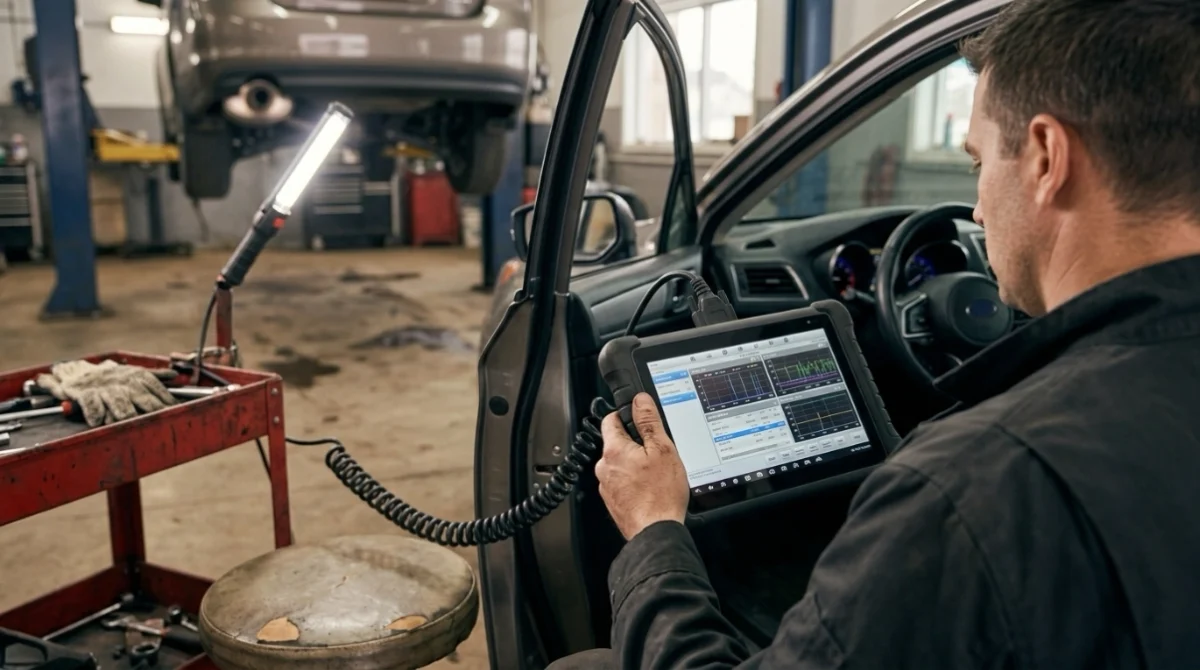
Start with the scan report rather than the parts catalog. I want to know what other codes are present and what conditions existed when P0430 set.
- Scan every stored and pending code. Record them before clearing anything.
- Review freeze-frame data. Note engine load, speed, temperature, and fuel-control conditions if your scanner provides them.
- Check for misfires. Repair active ignition or combustion faults before judging catalyst condition.
- Inspect the exhaust system. Look and listen for leaks before and around Bank 2 sensors and converter connections.
- Check sensor wiring. Inspect connectors, melted insulation, corrosion, and damaged harnesses.
- Review fuel trims. Large corrections can indicate an air, fuel, or sensor problem.
- Compare oxygen-sensor activity. Use manufacturer-specific specifications rather than assuming one universal waveform is correct.
- Use advanced test data if available. Some scan tools provide catalyst-monitor or Mode 6 results that add useful context.
- Confirm the repair. After correcting the underlying fault, allow the required readiness monitors to run again.
Do not replace an oxygen sensor just because its name appears near the converter in the diagnostic description. Test the sensor and its circuit first.
The same rule applies to the converter. A new catalytic converter can fail again if an unresolved rich condition or misfire keeps dumping excessive fuel into the exhaust.
For manufacturer-specific warning information and service resources, use the official owner resources for your vehicle. Toyota, for example, maintains an official warning-light reference.
If you suspect your exact vehicle has a known factory issue, you can also check NHTSA vehicle safety and recall resources using the vehicle information or VIN.
Technician’s note: catalyst testing can involve hot exhaust components and model-specific scan procedures. If you do not have the correct equipment, professional diagnosis is safer than replacing parts by trial and error.
P0430 Symptoms FAQ
Can P0430 appear with no symptoms?
Yes. Many vehicles with P0430 drive normally, and the Check Engine Light is the only noticeable symptom. The OBD system can detect reduced catalyst efficiency before the driver notices a major performance problem.
Does P0430 always mean the catalytic converter is bad?
No. A worn converter is one possible cause, but exhaust leaks, oxygen-sensor problems, engine misfires, incorrect fuel mixture, or engine contamination can also contribute. Diagnose those issues before replacing an expensive converter.
What is Bank 2 on a P0430 code?
Bank 2 is the cylinder bank that does not contain cylinder number one. Its physical location varies by engine design, so confirm the bank layout using service information for your exact make, model, year, and engine.
Can a bad oxygen sensor cause P0430?
Yes, a faulty or biased oxygen sensor can contribute to incorrect catalyst-monitor results. However, sensor replacement should follow testing because the same code can also result from a genuinely weak converter or another engine problem.
Can an exhaust leak trigger P0430?
Yes. A leak near the Bank 2 oxygen sensors or catalytic converter can alter oxygen levels in the exhaust and interfere with catalyst monitoring. Inspect flanges, pipes, flex sections, and sensor mounting areas for leaks.
Can P0430 cause a car to lose power?
It can when the catalytic converter is physically restricted or when another engine fault accompanies the code. If power drops severely, diagnose the vehicle promptly because a restricted exhaust or serious misfire can create additional damage.
Will clearing P0430 fix the problem?
No. Clearing the code only removes stored diagnostic information and resets certain monitors. If the underlying condition remains, the catalyst monitor can fail again and the Check Engine Light will return.
Final takeaway: P0430 symptoms can range from nothing more than a Check Engine Light to poor mileage, rough running, weak acceleration, or exhaust problems. The safest approach is to diagnose the engine, sensors, and exhaust system before assuming Bank 2 needs a new catalytic converter.
If you have an OBD-II scanner, save the full code list and freeze-frame information before clearing anything. That small step can make the difference between finding the real fault and replacing the wrong part.
