P0420 Repair Cost: What You’ll Pay and What Fixes It

Quick Answer
P0420 repair cost can range from roughly $100 for a small exhaust repair to $4,000 or more when the catalytic converter itself needs replacement. The code means catalyst efficiency on Bank 1 has fallen below the level expected by the engine computer, but it does not automatically prove the converter is bad. Current catalytic converter cost guidance from AAA shows why diagnosing the cause before buying parts matters.
Typical P0420 Repair Possibilities
- Exhaust leak: A leaking gasket, flange, flex section, or pipe can distort oxygen-sensor readings and may be one of the cheaper repairs.
- O2 sensor: A slow or faulty oxygen sensor can sometimes imitate poor catalyst performance and may cost several hundred dollars installed.
- Engine problem: Misfires, rich fuel mixtures, oil burning, or coolant contamination can trigger P0420 and damage the converter.
- Catalytic converter: If testing confirms the catalyst has lost efficiency, replacement commonly becomes a four-figure repair.
- Warranty coverage: Some catalytic converters may still qualify for federal or manufacturer emissions warranty coverage.
Before You Approve the Repair
- Ask the technician what testing confirmed the failed part instead of replacing the converter from the code alone.
P0420 is one of those OBD-II codes that can turn a simple Check Engine Light into an expensive quote. I’ve had drivers ask about it during other vehicle-electronics work because they were told the code automatically meant “buy a catalytic converter.”
That shortcut can become costly. This guide explains what you may pay in 2026, what can cause the code, and how to avoid replacing the wrong part.
In This Guide
What Does P0420 Mean?
P0420 means “Catalyst System Efficiency Below Threshold (Bank 1).” Your engine computer has determined that the Bank 1 catalytic converter is not performing as efficiently as expected.
Bank 1 is the side of the engine containing cylinder number one. On many inline engines, there is only one cylinder bank.
Definition: A catalytic converter is an emissions-control device in the exhaust system. It helps convert harmful exhaust gases into less harmful substances before they leave the tailpipe.
The powertrain control module does not normally measure converter health directly. It evaluates data from oxygen sensors positioned before and after the catalyst.
The upstream sensor helps the computer monitor the air-fuel mixture. The downstream sensor helps monitor how well the converter is working.
- Upstream O2 sensor: Located before the catalytic converter and responds to changes in exhaust oxygen.
- Downstream O2 sensor: Located after the converter and helps the computer evaluate catalyst performance.
- P0420: Appears when the catalyst-monitoring strategy detects efficiency below its programmed threshold.
A P0420 code therefore tells you where to investigate. It does not identify a replacement part with certainty.
That distinction matters because an exhaust leak, sensor problem, misfire, or fuel-control problem can affect the readings used to judge the converter.
Does P0420 always mean the catalytic converter is bad?
No. A degraded catalytic converter is an important possibility, especially on an older or high-mileage vehicle, but proper diagnosis should rule out other causes first.
A converter can also fail because another engine problem damaged it. Installing a new converter without correcting that cause can put the replacement at risk.
Pro tip: treat P0420 as a diagnostic starting point, not an automatic authorization to replace the most expensive exhaust component.
How Much Does P0420 Cost to Fix in 2026?
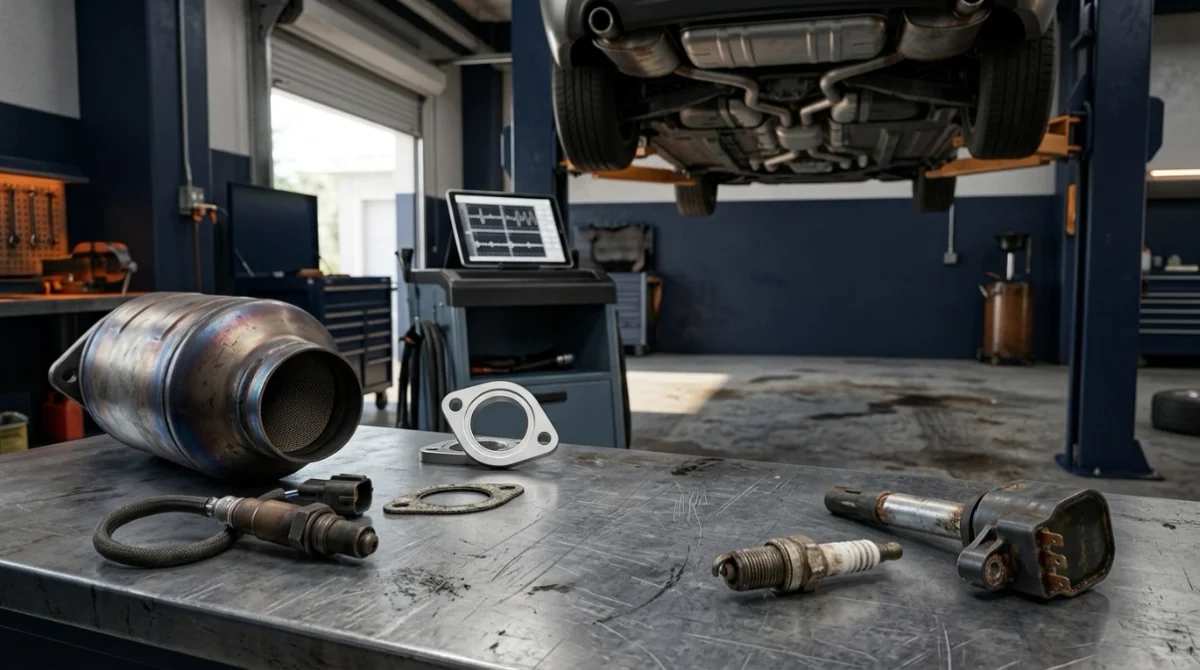
A realistic P0420 repair bill can range from around $100 to $4,000 or more. The final amount depends on the failed component, vehicle design, labor rate, emissions specification, and parts choice.
That wide range is exactly why diagnosis has value. A relatively small leak and a failed catalytic converter can produce the same stored P0420 code.
| Possible Cause | Typical Repair | Approximate 2026 Cost | What Affects Price |
|---|---|---|---|
| Small exhaust leak | Gasket, flange, or localized pipe repair | About $100–$400 | Leak location, corrosion, welding needs |
| Faulty O2 sensor | Oxygen sensor replacement | About $250–$550 | Sensor type, access, OEM versus aftermarket |
| Misfire or fuel-control fault | Repair underlying engine problem | Often $150–$700+, depending on cause | Plugs, coils, injectors, vacuum leaks, diagnosis |
| Failed catalytic converter | Converter replacement | Roughly $1,000–$4,000+ | Vehicle, OEM part cost, emissions standard, labor |
These are budgeting ranges, not quotes. Your make, model, engine, model year, state, and shop can move the price significantly.
Why is catalytic converter replacement so expensive?
Catalytic converters contain precious metals that support the chemical reactions needed to reduce exhaust pollutants. Vehicle-specific designs can also make the part expensive.
Labor is only part of the bill. On some vehicles, the converter is integrated into an exhaust manifold or packaged tightly near the engine.
- OEM parts: Usually cost more but match the original vehicle specification.
- Direct-fit aftermarket parts: May reduce the purchase price when legal and compatible.
- CARB-compliant applications: Can have additional emissions requirements in states following California rules.
- Multiple converters: Some vehicles use more than one catalyst, increasing diagnostic and parts complexity.
How much does an oxygen sensor cost for P0420?
Current national repair estimates put many oxygen-sensor replacements in the several-hundred-dollar range. Access and sensor design create large vehicle-to-vehicle differences.
Do not replace the rear sensor simply because P0420 mentions catalyst efficiency. The sensor should first be tested against live data and the rest of the exhaust system.
Locksmith’s note: when I’m already connected to a vehicle for electronic work, clearing a stored code may look tempting. Clearing P0420 only resets the warning temporarily; it does not repair the condition that triggered it.
Section Takeaway: P0420 is not a fixed-price repair. Spending money on diagnosis first can help separate a few-hundred-dollar problem from a multi-thousand-dollar converter replacement.
What Repairs Actually Fix P0420?
The correct P0420 repair is the one that fixes the condition causing the catalyst monitor to fail. Sometimes that is the converter, but several other faults should be considered.
1. Repairing an exhaust leak
A leak near the exhaust manifold, oxygen sensors, flange, flex section, or catalyst can introduce outside air. That can distort the oxygen readings used by the computer.
Repairing the leak may involve a gasket, clamp, weld, flange repair, or pipe replacement. Severe rust can turn a small repair into a larger job.
2. Replacing a failed oxygen sensor
Oxygen sensors operate in a harsh environment and can degrade with age. A slow or inaccurate sensor may interfere with catalyst monitoring.
The important word is failed. Replacing a sensor without testing it can waste money and leave P0420 unchanged.
3. Fixing a misfire or fuel-mixture problem
An engine that misfires or runs excessively rich can send unburned fuel into the converter. That extra heat can damage the catalyst.
Fuel-trim problems can also arise from intake leaks, sensor errors, injector faults, or other engine-management issues.
- Misfire codes: P0300 or cylinder-specific P0301–P0308 codes deserve attention first.
- Fuel-trim codes: Lean or rich mixture codes can point toward the root problem.
- Oil consumption: Burning oil can contaminate catalyst material over time.
- Coolant consumption: An internal coolant leak can also harm emissions components.
If those problems remain after a converter replacement, the new part may face the same damaging conditions.
4. Replacing the catalytic converter
A converter can eventually lose enough oxygen-storage and emissions-conversion capability to set P0420 consistently. Physical damage, contamination, overheating, or normal aging can contribute.
A technician should confirm the diagnosis before ordering the part. Converter prices vary dramatically by vehicle.
Pro tip: verify the vehicle’s VIN, engine, emissions certification, and applicable state rules before buying an aftermarket catalytic converter.
5. Updating vehicle software when applicable
Some manufacturers release technical service information or calibration updates for specific vehicles. A software-related catalyst-monitor issue is much less universal than a worn converter or exhaust fault.
That is why year, engine, and VIN-specific service information matters. Never assume a software update exists for your vehicle without checking manufacturer information.
Section Takeaway: fix upstream engine problems before condemning the converter. A new catalytic converter cannot compensate for an active misfire, incorrect fuel mixture, or contamination problem.
How Should P0420 Be Diagnosed Before Replacing Parts?
Start with all stored codes and live operating data, then move toward physical testing. Replacing the catalytic converter should come after the cheaper and more obvious causes have been checked.
- Scan every stored and pending code. Do not focus on P0420 if misfire, fuel-trim, or oxygen-sensor circuit codes are also present.
- Save freeze-frame data. This shows operating conditions when the computer recorded the fault.
- Inspect the exhaust system. Look for cracks, loose connections, rust holes, damaged flex sections, and leakage near O2 sensors.
- Review fuel trims and misfire data. Correct major engine-running problems before evaluating the catalyst.
- Graph oxygen-sensor data. Compare upstream and downstream behavior using a scan tool that supports live data.
- Check manufacturer service information. Look for applicable technical service bulletins, calibration information, or warranty coverage.
- Confirm catalyst failure. Only then should a costly converter replacement become the primary repair.
Can a basic OBD2 scanner diagnose P0420?
A basic code reader can confirm P0420, clear the code, and sometimes show freeze-frame information. That is useful, but it may not be enough to prove which component failed.
A scanner with graphing, live O2 data, fuel trims, and Mode $06 information can provide more diagnostic evidence. Vehicle support varies between scan tools.
What should you ask a repair shop?
You do not need to become an emissions technician to ask good questions. A few direct questions can reveal whether the quote is based on testing or only the trouble code.
- Were any other trouble codes stored?
- Was the exhaust checked for leaks?
- Were the upstream and downstream O2 sensors tested?
- Were fuel trims and misfire data normal?
- What test confirmed the catalytic converter failed?
- Is the proposed converter OEM, direct-fit aftermarket, or another type?
- Does the replacement meet the emissions requirements for my vehicle and state?
- Could any federal or manufacturer warranty apply?
I especially like the last question before a customer approves a large emissions repair. Warranty status can change the entire cost conversation.
Pro tip: get the diagnostic findings written on the estimate when the proposed repair costs four figures. It gives you something concrete to compare if you seek a second opinion.
Section Takeaway: a P0420 diagnosis should prove why the catalyst monitor is failing. The stored code by itself is not enough evidence to justify the most expensive repair.
Can You Drive With P0420, and Is It Worth Fixing?

A vehicle with P0420 often remains driveable, especially when the Check Engine Light is steady and there are no other symptoms. You should still diagnose it instead of ignoring the warning.
The vehicle may fail an emissions inspection while the code or related readiness issue remains present. A deteriorating converter can also become more restrictive in some failure modes.
When should you stop driving?
Do not treat every Check Engine Light the same way. A flashing light, severe misfire, major power loss, overheating, or strong abnormal exhaust behavior deserves prompt attention.
- Flashing Check Engine Light: Reduce driving and seek service because an active misfire can overheat the converter.
- Severe power loss: A restricted exhaust system may require immediate diagnosis.
- Strong rattling: Broken catalyst material or another exhaust component may be moving internally.
- Multiple engine codes: Diagnose the underlying running problem before continuing normal use.
If you are unsure whether another campaign applies to the vehicle, you can also check your VIN through the NHTSA recall lookup.
Is a P0420 repair worth it on an older car?
Compare the confirmed repair cost with the vehicle’s condition, value, inspection requirements, and other upcoming repairs. Avoid making that decision from the code alone.
A $200 leak repair and a $3,000 converter replacement create very different choices. Get the diagnosis first, then evaluate the economics.
Frequently Asked Questions About P0420 Repair Cost
How much does it cost to fix code P0420?
P0420 can cost roughly $100 for a minor exhaust repair to $4,000 or more for certain catalytic converter replacements. Oxygen-sensor repairs often fall in the several-hundred-dollar range. Vehicle make, engine, labor rate, emissions requirements, and the true cause determine your final price.
Can I fix P0420 by replacing the O2 sensor?
Only if testing shows that an oxygen sensor is causing incorrect catalyst-monitor data. P0420 does not automatically mean the downstream O2 sensor has failed. Check sensor operation, wiring, exhaust leaks, fuel trims, and other stored codes before replacing it.
Will P0420 go away after clearing the code?
Clearing P0420 turns off the warning and resets monitoring data, but it does not repair the fault. If the catalyst monitor detects the same condition again after the required drive cycles, the code and Check Engine Light can return.
Can bad spark plugs cause P0420?
Worn plugs can contribute if they cause an engine misfire. Repeated misfires can send unburned fuel into the catalytic converter, increasing heat and potentially damaging it. If misfire codes are present with P0420, diagnose the misfire first.
Can an exhaust leak cause P0420?
Yes. A leak near the manifold, oxygen sensors, or catalytic converter can affect the oxygen content measured in the exhaust. This can interfere with catalyst-monitor calculations, so checking for leaks is an important step before replacing the converter.
Is a catalytic converter covered under warranty?
Possibly. Under U.S. federal emissions-warranty rules, specified major emissions components such as catalytic converters can receive coverage for up to eight years or 80,000 miles, whichever comes first, subject to applicable warranty conditions. Always verify coverage using your vehicle’s warranty booklet and manufacturer.
Should I use an OEM or aftermarket catalytic converter?
Use a converter that is legal for your vehicle’s emissions certification and location. OEM units usually cost more, while compliant aftermarket units may reduce cost. Compatibility, emissions rules, warranty, installation quality, and the cause of the original failure matter more than price alone.
Final Takeaway: What Should You Do Next?
Do not approve a catalytic converter replacement just because your scanner shows P0420. Confirm the code, check other faults, inspect for exhaust leaks, review live O2 data, and rule out engine-running problems first.
If the converter is confirmed bad, expect the repair to be one of the more expensive outcomes. Current replacement pricing varies widely by model, with many jobs entering the four-figure range.
Before paying, check warranty coverage too. Ford owners can start with Ford Owner Support, while Toyota owners can review manuals and warranty resources through Toyota Owners.
Final pro tip: if a shop recommends a converter without checking for misfires, exhaust leaks, fuel trims, or O2 sensor behavior, ask for the diagnostic evidence or consider a second opinion.
