
P0402 Causes: Why EGR Flow Is Too High

Quick Answer
P0402 means the engine computer has detected more exhaust gas recirculation, or EGR, flow than expected. The most common causes include an EGR valve stuck open, carbon deposits preventing the valve from closing, faulty EGR control hardware, incorrect sensor readings, or an electrical problem. Ford’s OBD system documentation describes P0402 as an excessive EGR flow fault.
Common P0402 causes
- Stuck-open EGR valve: Exhaust gas continues entering the intake when the computer expects little or no EGR flow.
- Carbon buildup: Deposits can interfere with EGR valve movement or prevent the valve from seating correctly.
- Control system fault: A vacuum solenoid or electronic actuator may command more valve opening than intended.
- Sensor error: A MAP, MAF, differential-pressure, or EGR-position sensor can make the PCM calculate incorrect EGR flow.
- Wiring problem: Damaged wiring, corrosion, poor grounds, or connector problems may distort sensor or actuator signals.
- PCM issue: Computer faults are possible, but they should be considered only after the EGR system and its inputs are tested.
Best first check
- Read freeze-frame and live data with an OBD2 scanner before replacing the EGR valve. Related trouble codes often narrow the diagnosis considerably.
If your OBD2 scanner shows P0402, don’t automatically order an EGR valve. I’ve seen diagnostic trouble codes become expensive when the code description gets mistaken for a confirmed failed part.
P0402 tells you what the engine computer detected, not exactly which component caused it. This guide explains the most likely causes, symptoms, tests, and repair priorities for 2026 vehicles.
In This Guide
What Does Code P0402 Mean?
P0402 is a generic powertrain diagnostic trouble code indicating that the powertrain control module, or PCM, has detected excessive exhaust gas recirculation flow. In simple terms, too much exhaust gas appears to be entering the intake under the conditions being monitored.
P0402 definition: The measured or calculated EGR flow is higher than the PCM expects for the current operating conditions.
What does the EGR system do?
The exhaust gas recirculation system routes a controlled amount of exhaust gas back into the engine’s intake. That process helps manage combustion temperature and emissions.
The key word is controlled. The PCM does not want maximum EGR flow all the time.
Depending on vehicle design, the computer may evaluate EGR operation using several inputs:
- Mass airflow sensor, or MAF
- Manifold absolute pressure sensor, or MAP
- EGR valve position sensor
- Differential-pressure sensor
- Engine speed and load
- Intake temperature
- Coolant temperature
- Commanded EGR valve position
The exact monitoring strategy varies between manufacturers. That is why make, model, engine, and model-year service information matters during diagnosis.
Does P0402 always mean the EGR valve is bad?
No. The valve itself is one strong possibility, but P0402 can also appear when the PCM receives misleading airflow, pressure, or position information.
Think of P0402 as a measurement problem until testing proves the mechanical cause. That approach prevents unnecessary parts replacement.
What Are the Most Common P0402 Causes?
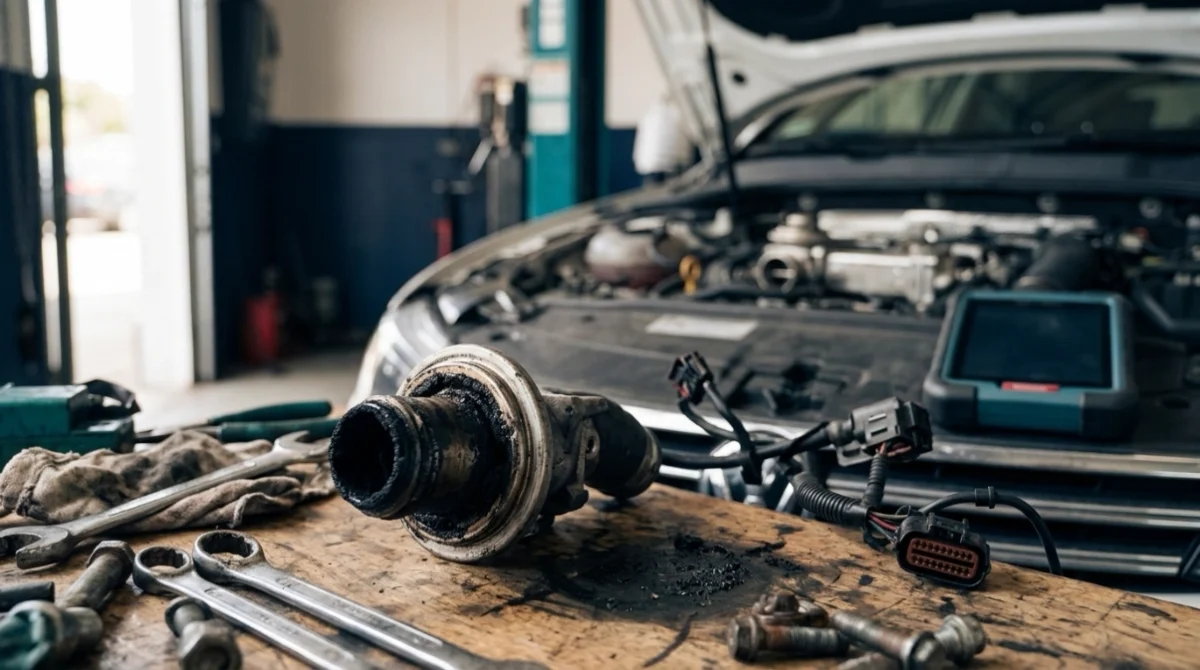
The most common P0402 causes involve an EGR valve that cannot close correctly or a control system that makes EGR flow appear excessive. Sensor and wiring problems should remain on the diagnostic list as well.
1. EGR valve stuck open
A stuck-open EGR valve is one of the first problems I would investigate. If the valve remains open at idle or during another condition where flow should decrease, the engine can receive too much recirculated exhaust.
A sticking valve may be caused by deposits, mechanical wear, actuator problems, or internal valve damage. Electronic valves can also fail without being visibly jammed.
2. Carbon and soot deposits
Carbon buildup deserves special attention because it can affect both valve movement and EGR passages. Deposits may hold the valve slightly off its seat even when the PCM commands it closed.
Ford has documented applications where excessive coking was associated with EGR-related trouble codes including P0402. That does not mean every P0402 vehicle needs EGR cleaning.
You can review the application-specific information in Ford’s EGR coking technical bulletin.
3. Faulty EGR control solenoid or actuator
Older vacuum-operated systems may use a control solenoid to regulate vacuum reaching the EGR valve. A leaking or incorrectly controlled solenoid can keep the valve open longer than intended.
Newer systems often use electronic EGR actuators. Scan data can be particularly useful because you may compare commanded EGR operation with reported valve position.
4. EGR position sensor problem
The PCM may rely on an EGR position sensor to determine how far the valve has opened. An incorrect signal can make the system appear mechanically different from its actual position.
Don’t condemn the sensor from P0402 alone. Check its signal against manufacturer specifications and compare it with commanded position when supported by your scan tool.
5. MAP, MAF, or differential-pressure sensor error
Some vehicles infer EGR flow from changes in manifold pressure, airflow, or exhaust pressure. A biased sensor can therefore contribute to an excessive-flow calculation.
Official Mitsubishi diagnostic information, for example, includes sensor data checks as part of P0402 diagnosis before certain components are replaced. See the manufacturer’s P0402 diagnostic information for an example of this approach.
6. Damaged wiring or connectors
An electrical fault can affect the EGR valve, control solenoid, position sensor, or other inputs used to calculate flow. Heat and vibration around the engine make connector inspection worthwhile.
- Look for loose terminals.
- Inspect wiring near hot exhaust components.
- Check connectors for moisture or corrosion.
- Verify power and ground where the service procedure requires it.
- Look for harness damage from previous repairs.
7. PCM or software problem
A PCM fault is possible, but it belongs near the bottom of the list. Manufacturer diagnostic procedures commonly direct technicians through component and circuit tests before computer replacement.
Software updates can also matter on certain applications. Check manufacturer service information by VIN before assuming the control module itself has failed.
Section Takeaway: P0402 does not automatically mean “replace the EGR valve.” A stuck valve is common, but deposits, control hardware, sensor inputs, wiring, and software can produce the same excessive-flow diagnosis.
What Symptoms Can P0402 Cause?
P0402 may cause rough idle, hesitation, stalling, poor low-speed operation, or a check engine light. Symptoms depend on how much unwanted EGR flow is occurring and when it happens.
Possible signs include:
- Check engine light: P0402 may appear with or without noticeable drivability symptoms.
- Rough idle: Excess exhaust gas entering at idle can interfere with stable combustion.
- Stalling: Severe unwanted EGR flow may make an engine difficult to keep running at low speed.
- Hesitation: The engine may respond poorly when leaving a stop or changing load.
- Reduced power: Some EGR faults can affect engine response and performance.
- Smoke or exhaust changes: Certain diesel applications may show smoke alongside EGR-system faults.
- Emissions inspection problems: An active emissions-related trouble code can prevent the vehicle from passing an OBD-based inspection.
A steady check engine light still deserves diagnosis. AAA recommends addressing check-engine warnings promptly and notes that an OBD2 scanner can help identify engine and exhaust-system faults.
If the engine is stalling, shaking badly, losing significant power, or producing unusual smoke or odors, avoid treating the code as a minor warning. Have the vehicle inspected promptly.
How Do You Diagnose P0402 Correctly?
Start with scan data before removing parts. A good P0402 diagnosis tries to determine whether excessive EGR flow is real, mechanically caused, or only being reported incorrectly.
Step 1: Scan every stored code
Record P0402 plus any pending, permanent, or manufacturer-specific codes. Related EGR, airflow, MAP, MAF, or actuator codes may change your diagnostic direction.
Save the freeze-frame information too. It shows operating conditions when the PCM recorded the fault.
Step 2: Inspect the EGR system visually
Check accessible EGR components before performing advanced tests. Look for disconnected hoses, damaged wiring, broken connectors, obvious leaks, and signs of previous repairs.
Vacuum-operated systems deserve close hose inspection. Electronically controlled systems need careful connector and harness checks.
Step 3: Compare commanded and actual data
If your scan tool supports the necessary data PIDs, watch commanded EGR operation and available feedback signals. Large inconsistencies can provide a useful direction.
Relevant data may include:
- Commanded EGR percentage or position
- Actual EGR position
- MAF readings
- MAP readings
- Engine RPM
- Coolant temperature
- Throttle position
- Differential EGR pressure
Manufacturer documentation is essential because normal values and test conditions vary. Never compare one vehicle’s expected readings with another engine’s specifications.
Step 4: Test whether the EGR valve closes
If supported, a professional scan tool may perform a bi-directional test that commands the EGR actuator. The technician can then watch valve feedback and engine response.
A vacuum-operated valve may require a different test procedure. Follow the service information for the exact engine rather than applying a generic vacuum value.
Step 5: Check sensors before replacing parts
A valve can operate correctly while another sensor makes airflow appear excessive. Compare suspect readings with related engine data and manufacturer reference values.
This matters especially when P0402 returns after an EGR valve has already been replaced. Replacing the same part twice rarely fixes a bad input signal.
Step 6: Clear the code and verify the repair
After correcting the confirmed fault, clear the code and perform the manufacturer-specified verification procedure. Some EGR monitors need particular operating conditions before they run again.
NHTSA-hosted service information also shows how EGR diagnostics may involve valves, coolers, sensors, actuators, and related airflow components rather than one isolated part. See this EGR diagnostic service document for an example.
Diagnostic note: if the test requires actuator commands, electrical measurements near hot exhaust components, or manufacturer-specific procedures, a qualified repair shop is usually the safer choice.
Section Takeaway: read all codes, save freeze-frame data, inspect the system, compare commanded and actual operation, and test the relevant sensors before buying an EGR valve.
What Is the Difference Between P0402 and P0401?
P0402 indicates excessive EGR flow, while P0401 indicates insufficient EGR flow. They involve the same emissions system but point in opposite diagnostic directions.
| Code | Basic Meaning | Typical Diagnostic Direction | Examples to Check |
|---|---|---|---|
| P0401 | EGR flow too low | Why isn’t enough EGR reaching the engine? | Blocked passages, valve not opening, control fault, incorrect sensor input |
| P0402 | EGR flow too high | Why is flow higher than commanded or calculated? | Valve stuck open, control fault, deposits, incorrect sensor input |
| P0404 | EGR control range/performance fault | Why isn’t actual EGR operation matching expected control? | Valve movement, actuator, position feedback, wiring |
| P0405/P0406 | EGR sensor circuit signal fault | Why is the EGR feedback signal outside its expected electrical range? | Sensor, connector, reference voltage, wiring, ground |
Ford’s OBD documentation specifically describes P0401 as a low-flow malfunction and P0402 as a high-flow malfunction. That distinction is useful when interpreting live EGR data.
Don’t assume carbon always produces P0401 because deposits can block flow. Deposits can also interfere with valve seating and contribute to excessive-flow behavior in some designs.
Can You Drive With a P0402 Code?

A vehicle with P0402 may still drive, but the code should not be ignored. How urgent it is depends on the engine’s behavior and whether other warning signs are present.
Driving a short distance for diagnosis may be reasonable when:
- The check engine light is steady.
- The engine idles normally.
- There is no major power loss.
- The vehicle is not stalling.
- There are no unusual noises, heavy smoke, or strong odors.
Stop driving or seek prompt assistance if the engine runs severely rough, stalls repeatedly, loses substantial power, or displays other serious warning indicators. A flashing check engine light also requires more urgent attention because it can indicate another fault such as an active misfire.
What should you fix first?
Fix the component testing proves faulty. Don’t start with the most expensive part or the most commonly mentioned part online.
A sensible diagnostic priority is:
- Read P0402 and all related codes.
- Save freeze-frame and live data.
- Inspect EGR wiring, hoses, connectors, and accessible components.
- Check whether the EGR valve closes properly.
- Verify sensor readings and valve feedback.
- Inspect for deposits or passage problems when indicated.
- Check manufacturer bulletins and software information.
- Consider PCM failure only after other causes have been ruled out.
This order prevents the classic parts-cannon approach. I’ve found that five extra minutes looking at related codes and freeze-frame information can be more useful than immediately reaching for a replacement component.
P0402 Frequently Asked Questions
Can a dirty EGR valve cause P0402?
Yes. Carbon or soot can interfere with EGR valve movement and may prevent the valve from fully closing. However, P0402 does not prove the valve is dirty, so inspect the system and scan data before deciding that cleaning will solve the problem.
Can a bad EGR valve cause P0402?
Yes. An EGR valve stuck partly or fully open can create more recirculated exhaust flow than the PCM expects. Mechanical sticking, actuator failure, and position-control problems can all contribute, depending on the system design.
Can a bad MAP or MAF sensor cause P0402?
Potentially. Some engine computers use manifold pressure or mass airflow changes when evaluating EGR operation. A biased sensor can affect the calculated flow, which is why sensor data should be checked before an EGR valve is automatically replaced.
Will P0402 clear itself?
The warning light may eventually turn off if the fault stops occurring and the vehicle completes enough successful monitor cycles. The stored diagnostic history may remain, and an intermittent mechanical or electrical problem can return later.
Can I clean the EGR valve instead of replacing it?
Cleaning may help when deposits are the confirmed reason a serviceable valve cannot close correctly. It will not repair a failed actuator, damaged position sensor, worn valve mechanism, wiring problem, or another faulty sensor.
Why did P0402 return after replacing the EGR valve?
A returning code suggests the original diagnosis may have missed another cause. Check wiring, connectors, sensor inputs, EGR passages, actuator commands, manufacturer software information, and whether the replacement valve operates correctly on that exact vehicle.
Do I need an advanced scan tool for P0402?
A basic OBD2 scanner can read the code, but live data makes diagnosis much easier. An enhanced or bi-directional scanner may be needed when the manufacturer procedure requires EGR actuator commands or vehicle-specific data parameters.
Final Takeaway
P0402 means the PCM has detected excessive EGR flow, but the code doesn’t identify the failed component by itself. A stuck-open EGR valve and carbon buildup are strong possibilities, while control, sensor, wiring, and software faults also deserve testing.
Start with your OBD2 scanner, save the freeze-frame information, and inspect the system before replacing parts. When testing requires manufacturer-specific actuator commands or electrical diagnosis, use the correct service information or have a qualified technician finish the diagnosis.
