
P0401 Causes: Why Your EGR Flow Is Too Low

Quick Answer
P0401 means the engine computer detected less exhaust gas recirculation, or EGR, flow than expected. Common P0401 causes include carbon-clogged EGR passages, a sticking EGR valve, control or vacuum problems, faulty EGR feedback sensors, damaged wiring, or restrictions elsewhere in the emissions system; an OBD2 scanner and proper diagnosis should come before replacing parts.
Most Common P0401 Causes
- Carbon buildup: Soot can restrict the EGR valve, tubes, cooler, or intake passages.
- Sticking EGR valve: The valve may not open enough when the computer commands EGR flow.
- Sensor failure: A pressure, position, MAP, or related feedback sensor may report incorrect flow.
- Vacuum problem: Vacuum-operated systems can lose control because of cracked hoses or faulty solenoids.
- Electrical fault: Corroded terminals, damaged wiring, or loose connectors can interrupt EGR control.
- Diesel restriction: Some diesel applications can develop soot restrictions involving the EGR cooler, filter, or DPF-related components.
Best First Step
- Read stored and pending codes, save freeze-frame data, and inspect the EGR system before clearing anything.
If your scanner just displayed P0401, don’t assume you need an EGR valve. The code tells you that EGR flow appears too low, but several different faults can create that result.
In vehicle-electronics work, I treat a trouble code as a starting point rather than a parts order. That approach matters with P0401 because carbon buildup, sensors, hoses, wiring, and the valve itself can produce similar scan results.
In This Guide
What Does P0401 Mean?
P0401 is a diagnostic trouble code indicating that the powertrain control module detected insufficient exhaust gas recirculation flow. The exact monitoring strategy varies by manufacturer, engine, and model year.
Definition: Exhaust gas recirculation, or EGR, is an emissions-control system that sends a controlled amount of exhaust gas back into the engine’s intake under specific operating conditions.
That exhaust gas helps control combustion temperatures and nitrogen oxide emissions. The engine computer therefore expects EGR flow to change when it commands the system on.
- Commanded EGR: What the computer is requesting.
- Actual EGR response: What the sensors indicate happened.
- P0401: The computer decides the observed response is lower than expected.
The important word is flow. P0401 doesn’t automatically prove that the valve itself has failed.
A clogged passage can block a perfectly functional valve. Likewise, a faulty feedback sensor can make normal EGR operation appear insufficient.
As of 2026, this distinction remains important because newer vehicles may monitor EGR operation using several data inputs. Depending on the design, those can include EGR position, pressure, airflow, manifold pressure, temperature, and other calculated values.
What Are the Most Common P0401 Causes?
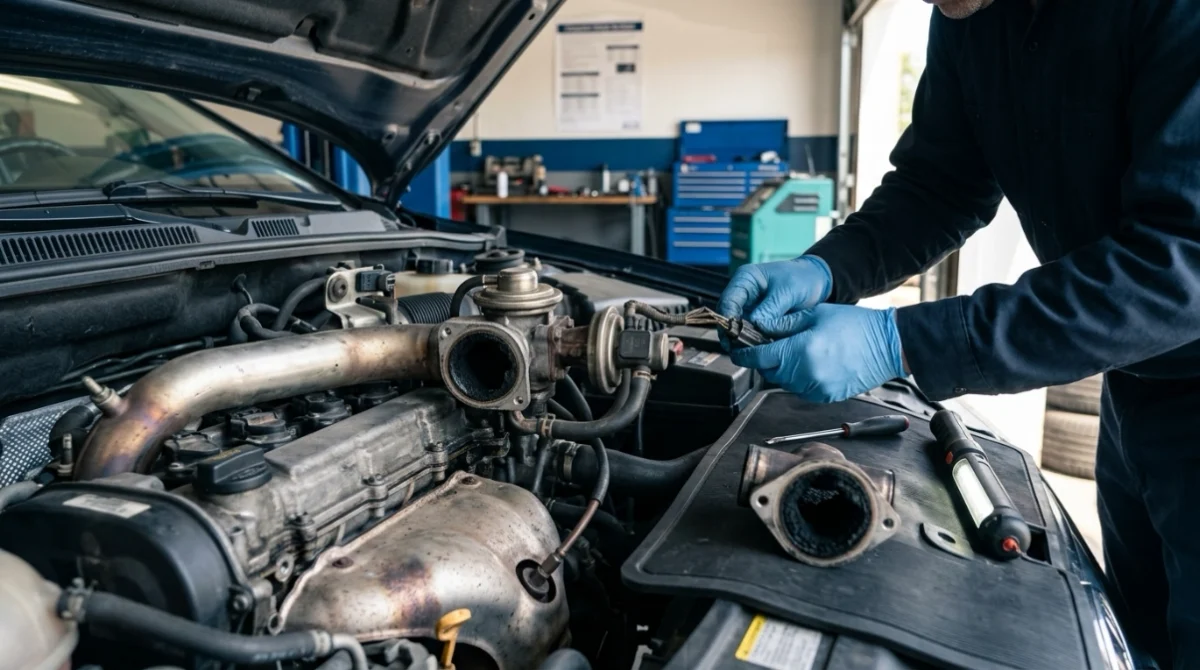
The most common P0401 causes involve a restriction, an EGR control problem, or incorrect feedback to the computer. Carbon buildup is often one of the first areas worth checking.
1. Carbon-Clogged EGR Passages
Exhaust contains soot and combustion deposits. Over time, those deposits can narrow the passages used to move exhaust gas into the intake.
The valve may still open when commanded. However, not enough exhaust can pass through the restricted path.
- EGR tubes can collect deposits.
- Intake EGR ports can become restricted.
- Diesel EGR coolers or filters may accumulate soot.
- The EGR valve throat can become heavily coated.
This is why replacing an EGR valve without inspecting the passages can leave the same P0401 code behind.
2. EGR Valve Stuck Closed or Not Opening Enough
An EGR valve can stick because of carbon deposits, mechanical wear, or an actuator problem. Electrically controlled valves can also fail internally.
A partially moving valve can be especially misleading. It may respond to commands but still fail to provide enough flow.
3. Faulty EGR Pressure, Position, or Feedback Sensor
Many systems rely on sensors to confirm that commanded EGR flow occurred. A bad sensor can therefore create P0401 even when the physical EGR passage isn’t completely blocked.
- EGR pressure sensors may report incorrect pressure changes.
- EGR position sensors can misreport valve movement.
- MAP or airflow readings may affect EGR calculations on some systems.
- Blocked sensor hoses or ports can distort pressure readings.
The sensor type depends on the vehicle. Always check manufacturer service information before judging a sensor from one scan value.
4. Vacuum Hose or EGR Control Solenoid Problem
Older and some specialized EGR systems use engine vacuum to operate the valve. A cracked hose or weak vacuum supply can prevent the valve from opening.
The control solenoid can also fail. That leaves the valve without the vacuum signal it needs.
- Split or disconnected vacuum hose
- Blocked vacuum passage
- Leaking diaphragm
- Failed EGR vacuum-control solenoid
- Incorrect hose routing after previous repairs
5. Wiring or Connector Damage
Modern electronic EGR valves depend on reliable power, ground, control, and sensor circuits. Heat around the engine can make wiring problems more likely over time.
Look for loose plugs, damaged insulation, backed-out terminals, moisture, or corrosion. Don’t condemn an electronic valve until its circuit has been checked.
6. Diesel EGR, Cooler, Filter, or DPF-Related Restriction
Diesel EGR systems can be more complex than simple gasoline-engine layouts. Soot accumulation may affect the EGR cooler, EGR filter, exhaust path, or related aftertreatment components.
Manufacturer-specific diagnosis matters here. A restriction that causes P0401 on one diesel engine may require a completely different test on another.
Section Takeaway: P0401 doesn’t identify one failed part. Check for blocked flow, poor valve operation, faulty feedback, control problems, and wiring before buying an EGR valve.
What Symptoms Can P0401 Cause?
P0401 can appear with nothing more than a Check Engine Light. Other vehicles may develop drivability symptoms depending on engine design and the severity of the EGR fault.
- Check Engine Light: This is often the first noticeable sign.
- Rough running: Some engines may idle or drive differently when EGR control is abnormal.
- Hesitation: Response can feel inconsistent under certain loads.
- Reduced performance: Some diesel vehicles may limit performance when emissions faults persist.
- Failed emissions test: An active emissions-related code can create inspection problems.
- Other stored codes: EGR, airflow, pressure, or emissions codes may appear with P0401.
A solid Check Engine Light and normal driving behavior don’t mean you should ignore the code. NHTSA vehicle resources can also help you check whether your vehicle has relevant safety information or manufacturer communications.
If the Check Engine Light is flashing, the engine is shaking badly, or power suddenly drops, treat that as a separate urgent warning. Stop driving when conditions make continued operation unsafe.
Professional note: P0401 severity varies by vehicle. If the engine is running poorly or multiple emissions codes are present, have the system diagnosed rather than repeatedly clearing the light.
How Do You Diagnose P0401 Correctly?
Diagnosing P0401 correctly means proving why EGR flow appears insufficient. Start with scan data and basic inspection before removing parts.
Step 1: Scan Every Stored and Pending Code
Connect an OBD2 scanner and record all stored, pending, and permanent codes available. Don’t clear them yet.
Related codes can change the direction of the diagnosis. An EGR circuit code, MAP sensor code, airflow code, or exhaust-related code may provide the missing clue.
Step 2: Save the Freeze-Frame Data
Freeze-frame data records operating conditions from around the time the fault was stored. Look at available information such as engine speed, load, coolant temperature, throttle position, and airflow.
Those values help show when the computer detected insufficient flow. They can also help you reproduce the operating condition later.
Step 3: Inspect the EGR System Visually
- Check EGR electrical connectors.
- Inspect visible wiring for heat or abrasion damage.
- Look for loose or damaged vacuum hoses.
- Inspect accessible EGR tubes and fittings.
- Check for obvious soot buildup around EGR connections.
Work only on a cool engine when touching EGR or exhaust components. Exhaust-system parts can become hot enough to cause serious burns.
Step 4: Check Live Data
A scanner with live data can show whether EGR commands and related sensor values change together. The exact parameters available depend on the vehicle.
If your scanner displays commanded EGR, EGR position, MAP, MAF, pressure, or temperature information, compare those readings with manufacturer specifications. One abnormal number isn’t enough without context.
Step 5: Command the EGR Valve if Your Scanner Supports It
Some bidirectional scan tools can command the EGR valve while you watch engine response and feedback data. This can help separate an electrical control problem from a blocked-flow problem.
Don’t force an actuator test when you’re unsure of the procedure. Follow vehicle-specific service information because test conditions differ between engines.
Step 6: Inspect for Carbon Restrictions
If commands and electrical operation look normal but measured flow stays low, inspect the EGR path for blockage. Carbon may hide deeper inside the passages.
This matters especially on diesel applications. NHTSA-hosted manufacturer communications have documented vehicle-specific P0401 cases involving heavy soot and EGR-system restrictions, which shows why model-specific service data matters.
Step 7: Test Sensors, Vacuum, and Wiring
Use the correct test for the system installed on your vehicle. That might involve a multimeter, vacuum gauge or hand pump, scan-tool graph, or manufacturer-directed circuit test.
Never apply voltage to an unknown terminal just to see whether a valve moves. Electronic actuators and control modules can be damaged by incorrect testing.
Locksmith’s note: P0401 is an engine and emissions diagnosis, not a key-fob or immobilizer fault. For advanced EGR circuit testing or component removal, use manufacturer service information or an emissions-qualified technician.
Section Takeaway: Preserve the codes and freeze frame first, then check the complete EGR path. Good diagnosis separates a blocked passage from a bad valve, sensor, vacuum control, or circuit.
How Is P0401 Different From Other EGR Codes?
P0401 specifically points toward insufficient EGR flow. Nearby EGR codes can indicate different problems, so don’t treat every P04xx code as the same repair.
| Code | General Meaning | What It Points Toward |
|---|---|---|
| P0400 | EGR flow malfunction | General EGR flow problem |
| P0401 | EGR flow insufficient detected | Too little detected EGR flow |
| P0402 | EGR flow excessive detected | Too much detected EGR flow |
| P0403 | EGR control circuit fault | Electrical or control-side issue |
| P0404 | EGR control range/performance | Valve response outside expected range |
| P0405/P0406 | EGR sensor circuit low/high | Feedback sensor or circuit problem |
A vehicle with P0401 plus P0403 deserves more electrical attention than a vehicle with P0401 alone. Likewise, P0401 combined with airflow or pressure codes may justify checking the sensors the computer uses to calculate EGR flow.
Always confirm the official description for your exact vehicle. Manufacturers can use different monitoring strategies even when the generic code number is the same.
How Do You Fix P0401?
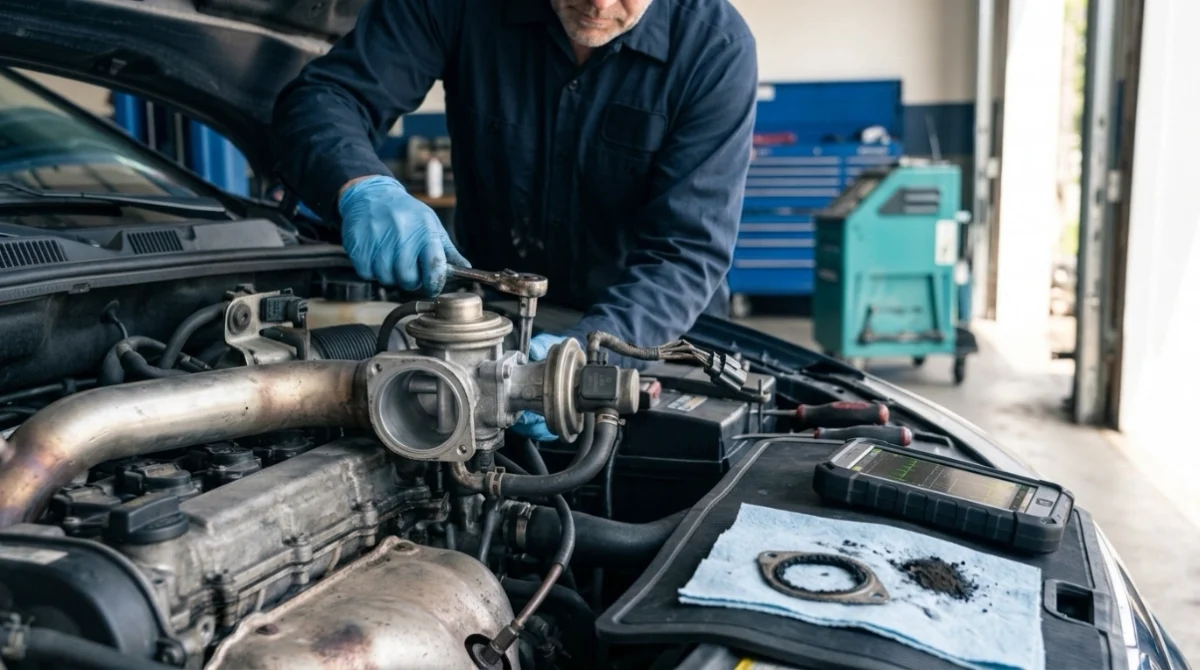
The correct P0401 fix depends on what testing proves. Don’t replace the EGR valve simply because its name appears in the code description.
Repair the Cause You Confirmed
- Blocked passages: Clean or repair the affected EGR passage according to manufacturer procedures.
- Failed EGR valve: Replace the valve if testing confirms the actuator or internal mechanism has failed.
- Damaged vacuum hose: Repair the leak and confirm proper EGR vacuum control.
- Bad control solenoid: Replace it only after verifying power, ground, vacuum, and control operation.
- Faulty sensor: Confirm the signal and circuit before replacing the sensor.
- Wiring damage: Repair corroded terminals, broken wiring, or poor connections correctly.
- Diesel soot restriction: Follow the manufacturer procedure for the specific EGR, cooler, filter, and aftertreatment layout.
Clear the Code Only After Repair
After the confirmed problem is repaired, clear the code and retest the vehicle. Watch live data and check whether P0401 returns.
Remember that clearing codes also resets diagnostic information and may reset emissions readiness monitors. Don’t use code clearing as the repair itself.
Check for Manufacturer Information
Before buying expensive parts, check your owner’s resources and manufacturer service information. You can also start with manufacturer support resources when researching a brand-specific EGR design.
Some vehicles have known diagnostic procedures that differ from generic troubleshooting. Vehicle year, engine, emissions package, and region can all matter.
What Does P0401 Repair Cost?
There isn’t one reliable P0401 repair price because the code can have several causes. A hose repair, passage cleaning, wiring repair, sensor replacement, and EGR assembly replacement involve very different parts and labor.
Get the fault diagnosed before approving a repair estimate. Labor rates, engine access, parts choice, vehicle age, and region can change the final cost significantly.
Cost note: ask the shop what test confirmed the failed component. A scan code alone shouldn’t be the only reason for an expensive EGR-system replacement.
Section Takeaway: Fix the confirmed cause, not the code name. Retest after the repair and make sure EGR response now matches what the engine computer expects.
P0401 Frequently Asked Questions
Can I drive with a P0401 code?
You may be able to drive normally when P0401 causes only a solid Check Engine Light, but the emissions fault still needs diagnosis. If the engine loses power, shakes, overheats, produces unusual smoke, or the warning light flashes, stop and have the vehicle checked promptly.
Does P0401 mean the EGR valve is bad?
No. P0401 means the computer detected insufficient EGR flow, not that it proved the valve failed. Carbon-clogged passages, vacuum leaks, control solenoids, feedback sensors, wiring faults, or diesel soot restrictions can all produce an insufficient-flow result.
Can a clogged EGR valve cause P0401?
Yes. Carbon deposits can restrict the valve opening or reduce flow through nearby EGR passages. However, inspect the entire flow path because cleaning or replacing only the valve won’t solve the problem when the blockage is farther downstream.
Can a bad sensor cause P0401?
Yes. Some vehicles judge EGR operation using pressure, position, manifold pressure, airflow, or related sensor information. Incorrect feedback can make the computer believe EGR flow is too low even when part of the system is operating normally.
Will cleaning the EGR valve fix P0401?
Cleaning can help when carbon buildup is the confirmed restriction, but it isn’t a universal P0401 fix. The passage, cooler, valve, sensors, vacuum controls, and electrical circuits should be checked so you don’t clean one component while leaving the real fault untouched.
Can an OBD2 scanner diagnose P0401?
An OBD2 scanner is the best starting tool because it retrieves codes, freeze-frame information, and available live data. Advanced scanners may also command the EGR actuator, but physical inspection and electrical, vacuum, or pressure testing may still be needed to confirm the cause.
Why does P0401 come back after replacing the EGR valve?
The code can return when the original valve wasn’t the real cause. Blocked EGR passages, incorrect sensor feedback, wiring faults, vacuum-control problems, or an unresolved diesel soot restriction can keep actual or calculated EGR flow below the expected level.
Final takeaway: P0401 is a low-EGR-flow diagnosis, not an automatic EGR-valve replacement. Save the scan data, inspect the flow path, verify valve control and sensor feedback, then repair only the fault you can confirm.
If you’re troubleshooting the code yourself, use your scanner to gather evidence before clearing it. For deeper electrical testing, heavy carbon removal, or diesel EGR work, use the correct factory procedure or a qualified repair professional.
