
How to Fix P0420: Diagnose Catalyst Efficiency Before Replacing Parts

Quick Answer
To fix P0420, don’t replace the catalytic converter until you diagnose why the catalyst monitor failed. Read every stored code, check for misfires and fuel-control problems, inspect for exhaust leaks, compare oxygen-sensor live data, and confirm catalyst performance before buying parts. You can also confirm the stored trouble code with AAA’s OBD diagnostic code tool.
Quick P0420 Fixing Order
- Scan all codes: Check stored, pending, and permanent codes before clearing anything.
- Fix misfires first: A rich or misfiring engine can damage a converter and trigger P0420.
- Check exhaust leaks: Leaks around the manifold, converter, or sensor areas can distort oxygen readings.
- Watch sensor data: Compare upstream and downstream oxygen-sensor behavior with a live-data scanner.
- Confirm the converter: Replace it only after other faults have been ruled out and catalyst efficiency still fails.
Before You Clear the Code
- Save freeze-frame and live-data information because clearing codes can erase useful diagnostic clues.
P0420 is one of those trouble codes that can turn a simple check-engine light into an expensive guessing game. I’ve seen drivers replace sensors and converters before anyone checked the conditions that caused the code.
This guide takes the opposite approach. We’ll diagnose the system logically, find the root cause, and replace only the parts that testing supports.
In This Guide
What Does Code P0420 Mean?
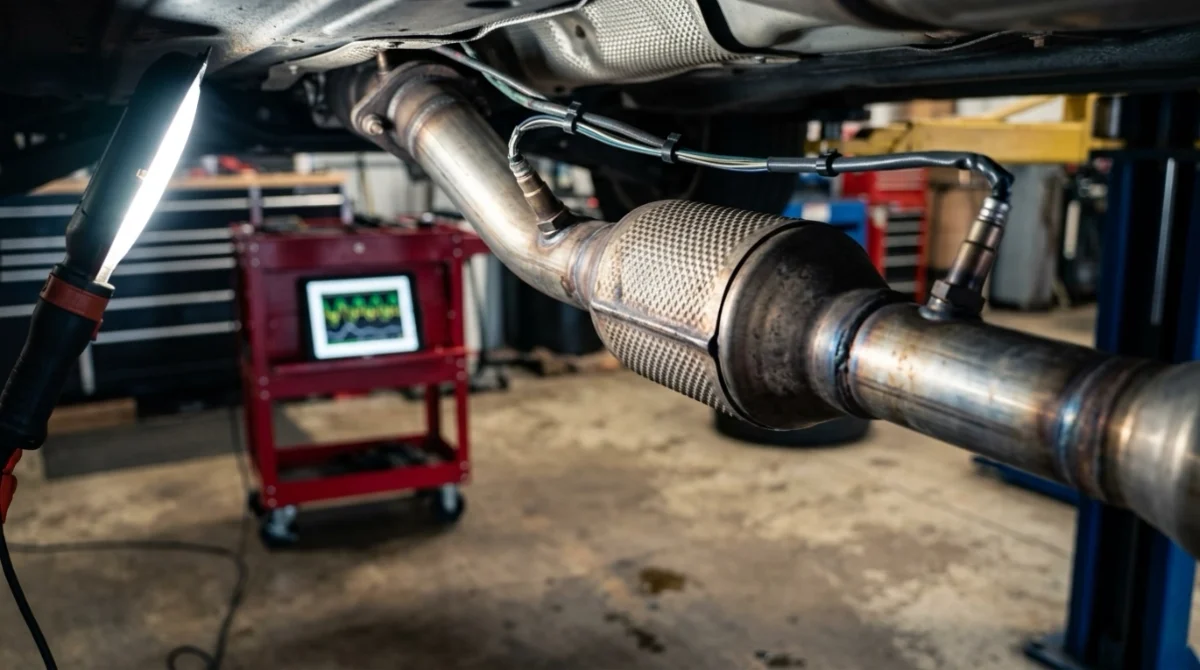
P0420 means “Catalyst System Efficiency Below Threshold (Bank 1).” The engine computer has determined that the Bank 1 catalytic converter isn’t reducing exhaust emissions as effectively as expected.
Bank 1 is the side of the engine containing cylinder number one. Inline four-cylinder and many inline six-cylinder engines normally have only one bank.
Definition: A catalytic converter is an exhaust-emissions device that converts harmful exhaust compounds into less harmful gases. The engine computer monitors its effectiveness using oxygen sensors and other diagnostic data.
How does the computer detect low catalyst efficiency?
Most gasoline vehicles monitor exhaust conditions before and after the converter. The sensor before the converter reports what leaves the engine, while the downstream sensor helps evaluate what leaves the catalyst.
A healthy converter changes the exhaust chemistry and stores oxygen. Because of this, downstream sensor activity should normally behave differently from upstream activity once the catalyst monitor is running.
If the downstream pattern becomes too similar to the upstream pattern, the powertrain control module may decide catalyst efficiency has fallen below its programmed limit. It can then store P0420 and illuminate the malfunction indicator lamp.
- Bank 1 Sensor 1: Usually the sensor located before the catalytic converter.
- Bank 1 Sensor 2: Usually the sensor located after the converter.
- PCM or ECM: The computer controlling and monitoring engine operation.
- Freeze frame: A snapshot of vehicle data captured when the fault was detected.
- Mode 6: OBD test-result data that some scanners can display for monitored systems such as the catalyst.
Don’t assume that P0420 identifies a failed part. A diagnostic trouble code identifies the system where the computer detected a problem.
That distinction saves money. AAA also notes that diagnostic codes provide clues for diagnosis rather than automatically proving that an expensive component needs replacement.
Can You Drive With a P0420 Code?
A vehicle with only P0420 and a steady check-engine light may still drive normally. However, you should diagnose it instead of ignoring the warning.
The situation changes when the engine is misfiring, losing power, overheating, or showing a flashing check-engine light. Those symptoms can indicate a more urgent problem.
When should you stop driving?
AAA explains that a steady check-engine light generally needs prompt diagnosis, while a flashing light can indicate a more serious fault. Their check-engine light guidance recommends addressing the underlying problem rather than continuing to ignore it.
- Flashing check-engine light: Reduce driving and get the vehicle diagnosed as soon as safely possible.
- Heavy misfire: Stop unnecessary driving because unburned fuel can overheat the converter.
- Major power loss: A restricted or damaged exhaust system may require immediate inspection.
- Strong burning smell: Park safely and have the exhaust and engine inspected.
- Steady light only: Arrange diagnosis soon, even if the car still feels normal.
P0420 also matters where emissions inspections apply. Clearing the light immediately before inspection usually doesn’t solve anything because readiness monitors may become incomplete.
The catalyst monitor must run again under the vehicle’s required operating conditions. If the underlying fault remains, P0420 can return.
What Causes a P0420 Code?
A worn catalytic converter is one possible cause, but it isn’t the only one. The best diagnosis asks why the computer believes catalyst efficiency is low.
1. A degraded catalytic converter
The catalyst material can lose efficiency through age, thermal damage, contamination, or physical deterioration. A damaged internal substrate may also restrict exhaust flow.
Converter failure sometimes happens after another engine problem has existed for a long time. Replacing the converter without correcting that root cause can damage the new part.
2. Engine misfires
A misfire can send oxygen and unburned fuel into the exhaust. That condition can distort catalyst monitoring and create excessive heat inside the converter.
- P0300 random misfire
- P0301-P030x cylinder-specific misfires
- Weak ignition coils
- Worn or incorrect spark plugs
- Injector or compression problems
If P0420 appears with a misfire code, diagnose the misfire first. Don’t start with the converter.
3. Rich or lean air-fuel problems
Fuel-control faults can also interfere with catalyst operation. Look carefully at codes involving fuel trim, airflow, fuel pressure, injectors, and oxygen-sensor feedback.
Excessively rich operation can send additional fuel into the converter. Persistent lean conditions can indicate vacuum leaks, airflow errors, fuel-delivery problems, or exhaust leaks.
4. Exhaust leaks
A leak can introduce outside air into the exhaust stream. That extra oxygen may change sensor readings and interfere with the catalyst monitor.
Pay special attention to leaks near the exhaust manifold, flex section, flanges, converter connections, and oxygen-sensor mounting points.
5. Oxygen-sensor or circuit problems
An oxygen sensor can become slow, biased, contaminated, or electrically faulty. Wiring damage and poor connector contact can produce misleading data too.
Don’t replace Bank 1 Sensor 2 simply because P0420 mentions catalyst efficiency. Test the sensor and its circuit first.
6. Oil or coolant entering the combustion chambers
Oil consumption or internal coolant leakage can contaminate the catalyst over time. A replacement converter won’t stay healthy if the contamination continues.
- Unusual oil consumption
- Persistent coolant loss
- Blue or white exhaust smoke
- Fouled spark plugs
- Related fuel-trim or misfire codes
Diagnostic note: When an expensive converter has failed, I always want to know what damaged it before installing another one.
Section Takeaway: P0420 can come from the converter, sensor data, exhaust leaks, or an upstream engine problem. Diagnose those possibilities before ordering parts.
How Do You Diagnose P0420 Correctly?
The safest approach is to work from information to testing, then from testing to parts. A capable OBD2 scanner with live data makes this much easier.
Step 1: Scan every module and save the data
Read stored, pending, and permanent powertrain codes before clearing anything. Record freeze-frame data for P0420 and any related codes.
- Engine RPM
- Coolant temperature
- Vehicle speed
- Fuel trims
- Engine load
- Oxygen or air-fuel sensor data
Related codes can completely change the diagnostic order. Misfire, oxygen-sensor, airflow, or fuel-control codes deserve attention before catalyst replacement.
Step 2: Check service information for your exact vehicle
P0420 diagnostic criteria vary by manufacturer, engine, model year, and calibration. Some vehicles also have manufacturer service information addressing catalyst-monitor behavior.
Use your VIN and exact engine specification when researching the fault. The NHTSA vehicle search is also useful for checking available vehicle safety information before major repairs.
Pro tip: never assume a diagnostic procedure for one engine applies unchanged to another model year or powertrain.
Step 3: Diagnose misfire and mixture faults first
Run the engine and inspect how it behaves. A rough idle, hesitation, fuel smell, or misfire counter activity deserves attention before catalyst testing.
Look at short-term and long-term fuel trims if your scanner supports them. Interpret those values using manufacturer specifications and the conditions under which the data was recorded.
Step 4: Inspect the exhaust system
Check the system when it’s safe and cool. Look for cracked joints, damaged flex sections, loose connections, black soot marks, and obvious leakage.
A smoke test can help locate small leaks that are difficult to hear. Repair confirmed leaks before judging catalyst efficiency.
Step 5: Compare upstream and downstream sensor behavior
Warm the vehicle fully and use graphing live data when possible. The exact sensor values depend on whether the vehicle uses conventional oxygen sensors or wideband air-fuel sensors.
| Observation | What It May Suggest | Next Check |
|---|---|---|
| Downstream activity is much steadier than upstream activity | Catalyst may still be storing oxygen effectively | Check monitor results and intermittent faults |
| Downstream pattern closely follows upstream pattern | Catalyst efficiency may be reduced | Rule out leaks and sensor faults before condemning converter |
| Sensor signal is stuck, implausible, or unusually slow | Sensor, wiring, heater, or circuit problem may exist | Perform manufacturer sensor and circuit tests |
| Misfire or abnormal fuel control appears simultaneously | Upstream engine fault may be influencing the catalyst | Repair engine problem before retesting catalyst |
Step 6: Check Mode 6 or catalyst-monitor test results
Some advanced scanners display onboard monitor test results through Mode 6. These results can help show how close a monitored system is to its programmed limit.
The identifiers and pass/fail limits aren’t universal. Use vehicle-specific service information instead of applying another manufacturer’s numbers.
Step 7: Confirm the repair with a proper drive cycle
After repairing the verified fault, clear codes only when appropriate. Then operate the vehicle under the conditions needed for its readiness monitors to complete.
Don’t assume one generic drive cycle works for every vehicle. Manufacturer procedures can differ considerably.
Section Takeaway: Scan first, preserve the evidence, correct related faults, inspect for leaks, analyze sensor behavior, and confirm the catalyst monitor before replacing the converter.
How Do You Fix P0420?

The correct P0420 fix depends on what testing reveals. Clearing the code is not a repair, and replacing random parts can make the diagnosis much more expensive.
If you find an exhaust leak
Repair the confirmed leak using the correct gasket, flange, pipe, or exhaust component. Then repeat the catalyst-monitor diagnosis.
Don’t use exhaust paste as a permanent substitute where the joint or component requires proper mechanical repair.
If you find a misfire
Repair the misfire before evaluating the catalytic converter again. The cause could involve ignition, fueling, air leaks, compression, or another engine-management fault.
If the misfire has existed for a long time, inspect catalyst performance afterward. The original fault may already have damaged the converter.
If fuel control is incorrect
Diagnose the rich or lean condition using codes, fuel trims, sensor data, and manufacturer procedures. Possible causes vary widely between engines.
- Air leaks
- Airflow-sensor problems
- Fuel-pressure faults
- Injector problems
- Sensor bias
- Exhaust leaks affecting feedback
If an oxygen sensor or circuit fails testing
Repair the wiring or replace the verified faulty sensor. Use a part that matches the exact vehicle application.
A sensor-looking connector isn’t enough to prove compatibility. Confirm the vehicle’s year, engine, emissions specification, and manufacturer requirements.
If the catalytic converter fails testing
Replace the converter only after you’ve corrected any condition capable of damaging the new one. Installation requirements vary by vehicle and local emissions rules.
Pro tip: with converter replacement, confirm the exact emissions configuration by VIN before ordering parts. Similar-looking converters may not be equivalent.
How much does P0420 cost to fix?
Cost depends on the failed component, vehicle design, labor rate, emissions specification, and region. Diagnosis is valuable because the difference between possible repairs can be substantial.
| Possible Repair | When It Makes Sense | Cost Guidance |
|---|---|---|
| Exhaust leak repair | Leak is physically confirmed | Varies widely by leak location and damaged parts |
| Oxygen-sensor replacement | Sensor or circuit testing confirms failure | AAA cites roughly $200-$500 for oxygen-sensor replacement in its general repair guidance |
| Misfire or fuel-system repair | Related fault is confirmed | Varies by root cause, parts, and labor |
| Catalytic converter replacement | Catalyst fails diagnosis after other causes are corrected | AAA cites roughly $1,000-$2,500 in general guidance, with vehicle-specific costs varying |
Those figures aren’t quotes for your vehicle. Converter design, precious-metal content, labor access, and emissions requirements can change pricing substantially.
If you aren’t equipped for exhaust testing or live-data diagnosis, use a qualified repair facility. AAA provides an Approved Auto Repair locator for drivers who want another option for professional diagnosis.
What should you avoid doing?
- Don’t keep clearing P0420: You erase useful information without correcting the fault.
- Don’t replace both O2 sensors automatically: The code doesn’t prove either sensor has failed.
- Don’t replace the converter first: Check upstream problems and exhaust leaks before spending that money.
- Don’t ignore misfires: They can create further catalyst damage.
- Don’t copy another car’s sensor values: Sensor technology and monitor strategies vary.
- Don’t use a warning-light workaround: Fix the emissions fault rather than masking the monitor.
One pattern I’ve seen repeatedly is a vehicle arriving after several parts have already been changed. Once we return to the original scan data, the missing clue is often a related fault that should have been diagnosed first.
That’s why I treat P0420 as a diagnostic process, not a shopping list.
Section Takeaway: Fix the proven root cause first. Replace the catalytic converter only when testing supports it and the conditions that could damage a replacement have been corrected.
P0420 Frequently Asked Questions
Does P0420 always mean the catalytic converter is bad?
No. P0420 means the computer detected catalyst efficiency below its calibrated threshold on Bank 1. Exhaust leaks, oxygen-sensor problems, misfires, fuel-control faults, and contamination can contribute, so diagnosis should come before converter replacement.
Can a bad oxygen sensor cause P0420?
Yes, a faulty or biased oxygen sensor can provide misleading information used by the catalyst monitor. However, P0420 alone doesn’t prove the sensor is bad. Compare live data, inspect wiring, and follow the manufacturer’s sensor tests before replacing it.
Can an exhaust leak cause P0420?
Yes. An exhaust leak near the monitored section can introduce outside oxygen and change sensor readings. Inspect the manifold, gaskets, flex section, flanges, converter joints, and sensor mounting areas before condemning the catalytic converter.
Will clearing P0420 fix the problem?
No. Clearing the code only removes stored diagnostic information and resets certain monitors. If the condition remains, the monitor can fail again and P0420 may return after the vehicle completes the required operating cycle.
Can bad spark plugs cause P0420?
Bad spark plugs can contribute indirectly if they cause an engine misfire. A persistent misfire can send unburned fuel into the exhaust and overheat the catalytic converter, so misfire codes and ignition faults should be repaired before catalyst replacement.
How do I know whether the catalytic converter or O2 sensor is bad?
Use scan data and vehicle-specific tests rather than guessing. Compare upstream and downstream sensor behavior, check the sensor circuits, inspect for exhaust leaks, review related codes, and use catalyst-monitor results where your scanner supports them.
Will P0420 fail an emissions inspection?
It can. A stored emissions-related fault, illuminated malfunction indicator lamp, or incomplete readiness monitor can affect an OBD-based inspection. Inspection requirements vary by location, so check your state or local program before testing.
Final takeaway: P0420 tells you that Bank 1 catalyst efficiency failed the vehicle’s monitored threshold. It doesn’t tell you which part to buy.
Start with a complete scan, repair related engine faults, inspect the exhaust, analyze sensor data, and confirm catalyst performance. That approach gives you the best chance of fixing P0420 once instead of paying for the same problem twice.
