
How to Fix P0325: Knock Sensor 1 Circuit Malfunction

Quick Answer
To fix P0325, confirm the code with an OBD-II diagnostic scan, inspect the Knock Sensor 1 wiring and connector, check for real engine knock or overheating, and test the sensor circuit using your vehicle’s factory specifications. Replace the sensor only after wiring, connectors, and engine conditions have been ruled out.
Quick P0325 Fixing Steps
- Scan all codes: Record P0325, related codes, and freeze-frame data before clearing anything.
- Check the engine: Look for overheating, low coolant, low oil, or obvious abnormal knocking.
- Inspect the circuit: Check the knock sensor connector and harness for damage, corrosion, looseness, or contamination.
- Test before replacing: Follow manufacturer procedures for checking the sensor signal and circuit.
- Repair the cause: Fix damaged wiring, poor connections, engine problems, or replace a confirmed failed sensor.
- Verify the repair: Clear the code, drive under normal conditions, and rescan the vehicle.
P0325 can look like a simple sensor problem, but replacing the knock sensor immediately is often the wrong first move. The code tells you there is a problem in the Knock Sensor 1 circuit, not which component has failed.
My rule with codes like this is simple: diagnose the circuit before buying parts. This guide explains how to approach P0325 with an OBD2 scanner, basic electrical checks, and the correct factory information for your vehicle.
In This Guide
What Does the P0325 Code Mean?
P0325 means the engine computer has detected a malfunction involving the Knock Sensor 1 circuit. On many vehicles, this refers to the sensor associated with Bank 1 or the only knock sensor on an engine with a single sensor.
A knock sensor is a vibration-sensitive sensor mounted on or near the engine block. It helps the powertrain control module, or PCM, recognize vibration associated with abnormal combustion.
When the PCM detects knock, it can adjust ignition timing to help protect the engine. P0325 appears when the expected knock-sensor circuit signal is missing, implausible, or outside the range the computer expects.
Important: P0325 does not automatically prove that the knock sensor itself is bad. Wiring problems and abnormal engine operating conditions can produce the same diagnostic result.
What Does “Sensor 1” Mean?
The exact location of Knock Sensor 1 depends on the engine design. On some engines it sits on the side of the block, while others place it beneath the intake manifold.
Don’t choose a sensor based only on the generic code description. Check the manufacturer’s service information for the correct sensor location and bank identification.
What Is Bank 1?
On engines with two cylinder banks, Bank 1 normally refers to the bank containing cylinder number one. Sensor naming and placement can still vary between manufacturers.
A four-cylinder engine may use only one knock sensor. In that situation, the P0325 description may simply refer to that single sensor circuit.
Section Takeaway: P0325 identifies a Knock Sensor 1 circuit problem. It does not identify the failed part by itself.
What Causes a P0325 Code?
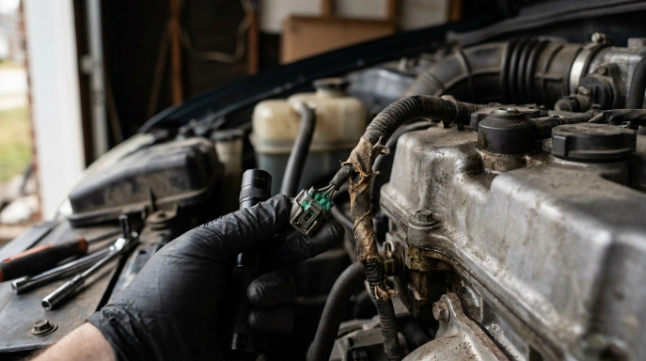
The most common P0325 causes involve the knock sensor, its wiring, or its electrical connection. Real engine problems can also complicate diagnosis.
- Failed knock sensor: Internal sensor damage may prevent a usable signal from reaching the PCM.
- Damaged wiring: Heat, vibration, oil contamination, abrasion, or previous repairs can damage the harness.
- Loose connector: A connector that is not fully seated can create an intermittent circuit.
- Corroded terminals: Moisture or contamination can increase resistance and disturb the signal.
- Open or shorted circuit: Broken conductors or unwanted contact with ground or power can trigger the code.
- Engine overheating: Excessive temperature can contribute to combustion knock and should be corrected before blaming the sensor.
- Lean combustion: A lean air-fuel condition may contribute to abnormal combustion and should be investigated when related codes are present.
- Mechanical engine noise: Abnormal internal vibration may affect what the sensor detects.
- PCM problem: Computer failure is possible but is much less common than sensor, connector, or harness faults.
Why Replacing the Sensor First Can Waste Money
A new sensor cannot repair a broken wire or corroded terminal. It also cannot fix an engine that is overheating or experiencing genuine combustion knock.
One of the most useful habits in OBD-II diagnosis is checking related codes first. Cooling-system, mixture, misfire, or sensor-reference problems may reveal a larger issue.
Technician’s note: never order a knock sensor from the diagnostic code alone. Verify the exact part and application with your VIN and manufacturer information.
What Are the Symptoms of P0325?
The Check Engine Light is the most common P0325 symptom, and some vehicles may show few noticeable driving symptoms. Others can lose power or develop audible pinging under load.
- Check Engine Light: The PCM stores P0325 after detecting the circuit fault.
- Reduced acceleration: The computer may use conservative ignition timing when reliable knock information is unavailable.
- Engine pinging: Metallic pinging during acceleration can indicate actual abnormal combustion that needs attention.
- Poor performance: The engine may feel less responsive, especially when climbing hills or accelerating.
- Fuel economy changes: Altered ignition control can sometimes reduce efficiency.
- No obvious symptoms: Some drivers notice nothing except the warning light.
Don’t judge severity from the warning light alone. AAA recommends investigating a Check Engine Light promptly because the underlying fault can range from minor to serious.
You can review AAA’s Check Engine Light guidance when deciding whether a warning condition needs immediate attention.
Can P0325 Cause Engine Knocking?
P0325 itself describes the sensor circuit, so it doesn’t prove that the engine is physically knocking. However, the sensor is part of the system the PCM uses to respond to knock.
If you hear strong metallic pinging, knocking, or rattling during acceleration, don’t assume the sensor is the only problem. Abnormal combustion, overheating, incorrect fuel, or mechanical problems may require separate diagnosis.
How Do You Diagnose P0325 Before Replacing Parts?
Start with scan data, then inspect the engine and electrical circuit before testing or replacing the sensor. This order reduces the chance of replacing a good component.
1. Scan the Vehicle and Save the Data
Connect an OBD2 scanner and confirm that P0325 is present. Record whether it is pending, stored, or permanent if your scanner provides that information.
Save the freeze-frame data before clearing codes. Freeze-frame information can show engine speed, load, temperature, and other conditions present when the code was stored.
Also record every related code. A coolant-temperature, lean-condition, misfire, or electrical code may change your diagnostic direction.
2. Check Basic Engine Conditions
- Verify the coolant level when the engine is safely cooled.
- Look for evidence of overheating.
- Check the engine-oil level and condition.
- Listen for unusual mechanical noise.
- Look for disconnected vacuum hoses or obvious intake problems.
If the engine is overheating or making severe mechanical noise, address that first. A sensor-circuit code shouldn’t distract you from a potentially damaging engine condition.
3. Inspect the Sensor Connector and Harness
Locate Knock Sensor 1 using a reliable service diagram for the exact year, make, model, and engine. Access can range from easy to difficult depending on the engine.
- Look for broken or chafed wires.
- Check for melted insulation near hot components.
- Inspect terminals for corrosion or contamination.
- Confirm the connector locks securely.
- Check whether previous repairs stretched or pinched the harness.
Oil and coolant leaks deserve attention because contamination can reach electrical connections. Repair the source of the leak as well as the damaged circuit.
4. Use Live Data When Your Scanner Supports It
A more capable scan tool may display knock-related data, ignition timing, or knock-retard information. Available parameter IDs vary widely by vehicle.
Compare the readings with other engine data rather than focusing on one number. Generic scanners may not expose every manufacturer-specific parameter.
5. Test the Circuit Using Factory Specifications
Electrical testing may involve a digital multimeter and the vehicle’s wiring diagram. The correct resistance, voltage, terminal identification, and test method vary by manufacturer.
Do not apply a generic resistance specification or voltage to every knock sensor. Some sensors and control strategies work differently.
| Diagnostic Finding | What It Suggests | Best Next Step |
|---|---|---|
| Visible harness or connector damage | Circuit integrity problem | Repair the wiring or connector before replacing the sensor |
| Circuit passes checks but sensor fails manufacturer test | Likely failed knock sensor | Replace the confirmed faulty sensor |
| P0325 appears with overheating | Engine operating condition may be contributing | Diagnose the cooling problem before final verification |
| Audible pinging plus mixture-related codes | Possible real combustion knock | Diagnose fuel, intake, ignition, and engine conditions |
| Sensor and circuit test correctly but code returns | Intermittent fault or less common control problem | Use factory diagnostic procedures and advanced testing |
You can also check your VIN through the NHTSA recall lookup for open safety recalls. A stored P0325 code by itself does not mean your vehicle has a recall.
Diagnostic note: disconnecting control modules or probing terminals incorrectly can cause damage. Follow the manufacturer’s service information whenever electrical testing goes beyond visual inspection.
Section Takeaway: confirm P0325 with scan data, inspect the engine and harness, then test against vehicle-specific specifications. Don’t use the code as a parts-ordering instruction.
How Do You Fix P0325 Step by Step?
The correct P0325 repair depends on what failed during diagnosis. The repair might be a connector fix, harness repair, knock sensor replacement, or correction of an engine condition.
Step 1: Repair Damaged Wiring or Connections
If inspection found broken, corroded, melted, or chafed wiring, repair that problem first. Make sure the harness is routed away from excessive heat and moving components.
Connector terminals should fit securely and remain free of oil, coolant, and heavy corrosion. A loose terminal can create an intermittent fault that returns after the car leaves the driveway.
Step 2: Replace the Knock Sensor Only if Testing Supports It
If the circuit is intact and the sensor fails the manufacturer’s test, replacement may be appropriate. The physical job varies dramatically between engines.
Some sensors are accessible from outside the block. Others sit beneath an intake manifold and require considerably more disassembly.
Use the correct sensor for the exact vehicle and engine. Match parts using reliable catalog information and the VIN where possible.
Repair note: sensor tightening procedures matter because a knock sensor responds to vibration. Use the manufacturer’s installation and torque specification rather than guessing.
Step 3: Correct Real Engine Problems
If the engine is overheating, running lean, misfiring, or making abnormal mechanical noise, diagnose those conditions. Replacing a sensor won’t correct the underlying engine fault.
- Repair cooling-system faults that cause excessive temperature.
- Investigate lean-condition codes or unmetered-air leaks.
- Correct misfires before judging knock-sensor operation.
- Investigate persistent metallic engine noise.
- Use the fuel grade required by the vehicle manufacturer.
Step 4: Clear the Code and Verify the Repair
After the repair, clear the diagnostic codes with your scanner if appropriate. Start the engine and make sure there are no immediate warning signs.
Drive the vehicle through normal operating conditions while monitoring for the Check Engine Light. Rescan afterward for pending, stored, or returning P0325 faults.
A code that returns immediately often points to an electrical fault that remains active. A code returning only under certain loads or temperatures may require deeper intermittent-fault testing.
Step 5: Don’t Keep Replacing Parts if P0325 Returns
If a replacement sensor doesn’t solve P0325, stop swapping components. Recheck the harness, connectors, grounds, related engine conditions, and manufacturer diagnostic information.
A control-module problem is possible, but it should remain low on the suspect list until the sensor and circuit have been properly verified. Module replacement can also require manufacturer-specific programming.
Section Takeaway: fix the fault you can prove. Wiring repair, sensor replacement, and engine repair are different solutions to different P0325 causes.
P0325 Frequently Asked Questions
Can I Drive With a P0325 Code?
You may be able to drive a vehicle with P0325 if it runs normally and the Check Engine Light is steady. However, you should diagnose it soon because the PCM may not have reliable knock-sensor information.
Is P0325 Always a Bad Knock Sensor?
No. P0325 can result from a failed sensor, damaged wiring, poor connector contact, an open or shorted circuit, or abnormal engine operating conditions.
Where Is Knock Sensor 1 Located?
Location depends on the engine. It may be mounted on the block, near the cylinder head area, or beneath the intake manifold, so confirm the location with vehicle-specific service information.
Can a Bad Connector Cause P0325?
Yes. Loose, corroded, contaminated, or damaged terminals can interrupt the signal between the knock sensor and PCM and cause the code to return intermittently or continuously.
Can Low-Quality Fuel Cause P0325?
Fuel that contributes to real combustion knock can complicate diagnosis, but P0325 specifically identifies a sensor-circuit malfunction. Use the fuel grade specified by the manufacturer and diagnose the electrical circuit instead of assuming fuel alone caused the code.
Will Clearing P0325 Fix the Problem?
No. Clearing the code only removes stored diagnostic information temporarily. If the PCM detects the same fault again, P0325 will return.
Can an OBD2 Scanner Tell Me Exactly What Part to Replace?
No. An OBD2 scanner identifies diagnostic trouble codes and may provide freeze-frame or live data, but the code is a starting point for testing. Wiring inspection and vehicle-specific diagnostic procedures are still required.
When Should You Stop Driving or Get Professional Help?
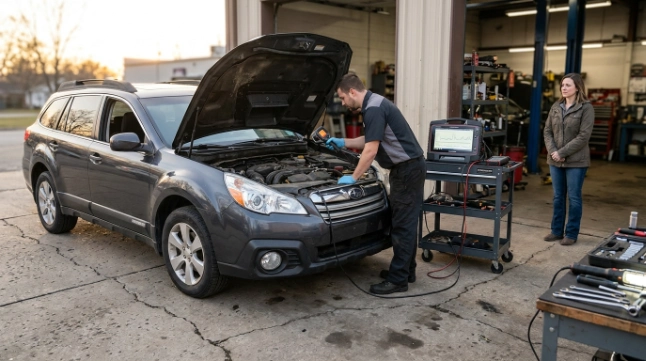
Get professional help if P0325 appears with severe engine knocking, overheating, major power loss, or other abnormal behavior. Continuing to drive while the engine has a serious mechanical or cooling problem can make repairs more complicated.
If the Check Engine Light is flashing, treat that as a more urgent warning than a steady light. Move to a safe location if the vehicle is shaking, losing power, or behaving abnormally.
P0325 also becomes a good professional-diagnostic job when the knock sensor sits beneath major engine components. The same applies when the circuit needs oscilloscope testing or manufacturer-level scan data.
An AAA Approved Auto Repair facility locator can help you find repair options if the diagnosis is beyond your equipment or experience.
The most important point is to avoid guessing. Read the code, preserve the data, inspect the circuit, test according to factory specifications, repair the proven fault, and verify that P0325 stays gone.
A successful P0325 repair isn’t the one that replaces the most parts. It’s the one that identifies why the Knock Sensor 1 circuit failed and proves the fault is fixed.
